Creekbank Stories Curt Iles, Storyteller
A Broken Cup
Interview Questions & Suggested Answers | Curt Iles
Learn more at www.creekbank.net/a-broken-cup
Amazon/A Broken Cup/Curt Iles
The Book and Its Message
Q. What is A Broken Cup about?
A. It’s my account of struggling with depression and finding my way forward. I wrote it as a fellow struggler, not an expert. The heart of it is simple: You’re not alone, and you’ll get through this.
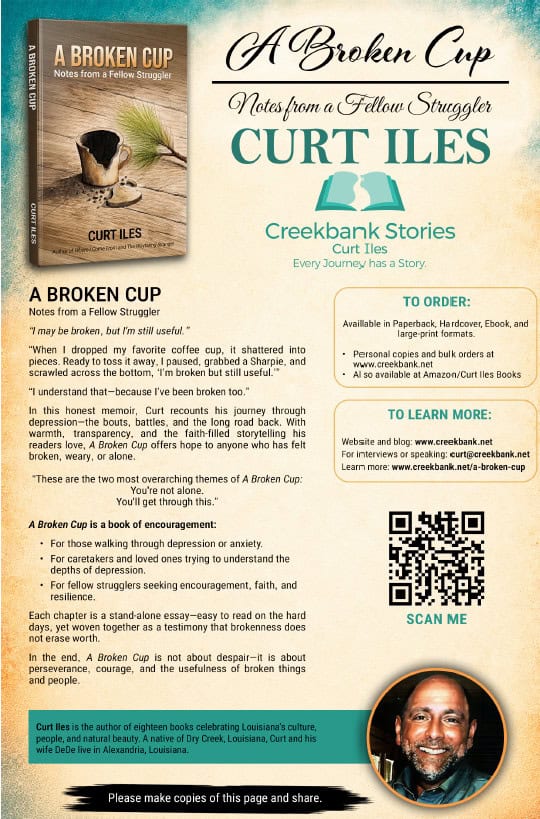
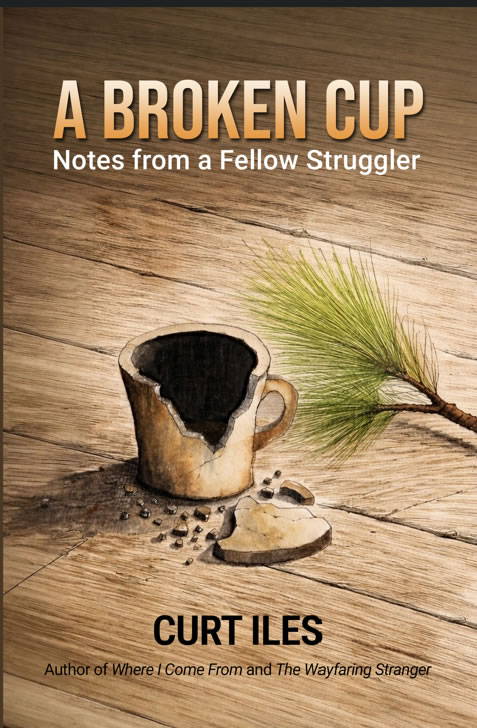
A. I dropped a favorite coffee cup and broke it. Instead of throwing it away, I wrote a reminder on it: “I’m broken but still useful.” That cup became a picture of something I needed to believe about myself—and something I hope readers will believe about themselves.
Q. Why the subtitle Notes from a Fellow Struggler?
A. I am a fellow struggler. I don’t have it all figured out. I also know that everyone has struggles in some way. I’m not standing on a mountaintop shouting instructions. I’m walking the trail with the reader, sharing what I’ve learned and what I’m still learning.
Q. Why did you decide to tell such a personal story?
A. I felt compelled to share my story. Depression can make a person feel isolated. I wanted to put an honest face and voice on the struggle. If telling my story helps one person feel less alone, it’s worth the vulnerability.
Q. Who did you write this book for?
A. For people in a dark season, for their family and friends who want to understand, and for anyone who needs encouragement to keep going. Some readers will recognize their own experience; others will better understand someone they love.
Q. Is this a book about despair or hope?
A. I don’t hide the hard parts, but the destination is hope. The point isn’t that life never breaks us. It’s that brokenness doesn’t erase our value or mean our story is over.
Faith, Depression, and Recovery
Q. How does faith fit into the story?
A. Faith runs through my life and my writing, but I don’t pretend faith makes every hard day easy. I want to be honest about the struggle and about the ways God meets us in it.
Q. Why do you spend time with the biblical story of Elijah?
A. Elijah’s journey fascinates me. After the victory on Mount Carmel, he ends up exhausted and afraid under a broom tree. It reminds me that even strong, faithful people can reach a breaking point.
Q. Do you plan to publish a Bible Study from the Elijah chapters in A Broken Cup?
A. Yes. It is a favorite part of the book for many readers. Elijah’s story in I Kings 17-22 and II Kings 1-2 is a remarkable story of a great Man of God who experiences great victories as well as times of despair. I plan to prepare the book, “On The Run With Elijah,” as I teach Elijah’s story to small groups, Bible studies, and Men’s groups.
Q. What is unique about Elijah’s time under the broom tree?
A. Before there’s a big speech or a new assignment, there’s care for a worn-out man. Rest and nourishment matter. Sometimes the next faithful step is to receive help and recover strength.
Q. Can a person experience depression and still have strong faith?
A. Absolutely. Struggling emotionally doesn’t automatically mean a person lacks faith. We need more compassion and fewer quick judgments. As our title suggests, being broken doesn’t disqualify a person from being useful. It can actually open up new opportunities to help others.
Seeking medical help is not opposed to one’s faith. It’s faith and medical help. Reach out for professional care from gifted healers who deal with mental illness on a daily basis.
I like the quote, “Your deepest pain can give you your highest platform.”
Q. What has helped you through hard seasons?
A. I’ve learned the importance of rest, trustworthy people, practical habits, and getting appropriate help. Having the support of family, small groups, and a church family. There isn’t one magic answer. Recovery often comes through many small, faithful steps.
Q. What do you mean by building a team?
A. Don’t try to carry every burden alone. Have people who can listen, tell you the truth, pray with you, and help you take the next step. Professional support can be an important part of that team, too.
Q. What do you mean by a toolbox?
A. I mean the practical resources you can reach for when a hard day arrives: people to call, routines that steady you, reminders of what’s true, and ways to care for your body and spirit.
Q. Why did you choose to make an Audible audiobook of A Broken Cup?
A. I want my writing and words to have maximum reach and impact. Having A Broken Cup in an audio format means more people can be impacted by what I feel is the most important book I’ve written to date.
Recording an audiobook of 250 pages/50 chapters is not for the faint of heart. I’m fortunate to work with a gifted audio engineer who cleaned up distractions without removing my Dry Creek drawl. I believe my speaking voice is a tool God uses to spread moving stories that inspire and encourage.
People ask, “Did you read the audiobook version?” My readers expect authenticity from my writing. Not a Bot, AI, or Voice Actor
Q. What should someone say to a friend who is struggling?
A. Start with presence. Listen without trying to fix everything in five minutes. A simple “I’m here, and I’ll stay with you” can mean more than a polished speech.
Storytelling and Louisiana Roots
Q. How is A Broken Cup connected to Creekbank Stories?
A. Creekbank Stories has always been about sharing moving stories that encourage and inspire. This book may be more personal than some of my others, but it comes from the same place: I believe stories help us understand each other. Anthony DeMello says it so well, “The shortest distance between the truth and a human heart is a story. I’m a storyteller.
Q. How has growing up in Dry Creek shaped your writing?
A. The Louisiana Pineywoods gave me a love for ordinary people, good stories, and the wisdom hidden in everyday life. I carry those people and places into nearly everything I write.
I love this Wallace Stegner quote: “Tell me where you’re from, and I’ll tell you who you are.
I am the product of a special rural community that surrounded me with love, wisdom, and stories. I seek to be a good steward and pass on what I’ve learned.
Q. Why do you weave humor into a serious book?
A. Because even in hard seasons, life has moments that make us smile. Humor doesn’t erase sorrow, but it can give us enough breathing room to keep going. My favorite stories are poignant: they contain humor and then impart an inspirational thought that moves readers (and listeners) from laughter to tears.
Q. What role does the Old House play in your storytelling?
A. The Old House, built by my ancestors in 1892, connects me to family, memory, and the stories that shaped me. Places like that remind me where I came from and what matters.

Q. How have your different careers influenced your writing?
A. I’ve been a teacher, coach, principal, camp manager, missionary, and writer. Every one of those roles taught me something about people. And people are at the center of my stories.
One common thread in each season and career of my life has been mentoring and coaching young people, especially young men.
Q. What makes this book different from your earlier books?
A. It asks me to be especially vulnerable. I still tell stories, but this time I’m also inviting readers into parts of my own life that haven’t always been easy to talk about.
For Readers and Interviewers
Q. How should someone read A Broken Cup?
A. There’s no need to rush. The chapters work as individual essays, so a reader can take one at a time—especially on days when concentration and energy are scarce.
Q. What do you hope family members and caregivers take away?
A. Please don’t assume you can see the whole struggle from the outside. Be patient, stay close, ask good questions, and remember that understanding often begins with listening.
Q. What would you say to someone who feels broken today?
A. You may feel broken, but you are not worthless. You are not alone. Take the next step, however small it is, and let someone walk beside you. Being depressed is not a sin or a moral failure. It is a mental illness that is treatable by good doctors and gifted healers.
Q. What do you hope readers remember after the last page?
A. Two things: You’re not alone, and you’ll get through this. And one more: A broken cup can still be useful.
Q. What question do you wish interviewers would ask?
A. Maybe this one: “What did you learn about the value of a person during your hardest days?” My answer is that our worth is not measured by how strong or productive we feel at a particular moment. God still uses broken people for His glory.
Short closing answer:
“I wrote A Broken Cup because I believe the person who feels broken still has a story, still has worth, and still has something to offer. We’re fellow strugglers—and we don’t have to walk alone.”
website: www.creekbank.net
All 18 of our books are available at Amazon/Curt Iles Books