Eliza Iles in Africa
The following fascinating article is from a Beaumont Daily Journal article in November 1920. It features a letter from the Belgian Congo, Africa written by my great-grandfather’s sister, Eliza Iles: Headline: Miss Eliza Iles writes of trip to Congo, Africa Miss Eliza Iles, who was deaconess for the First Methodist church in this city for three years and is now in Africa doing mission work, has written an interesting account of her trip to her uncle, Dr. D.C. Iles of Lake Charles. The letter was written November 12, 1920 from Wembo, Niama, Lusambo, Congo Belgi, Africa, and the following extract from the letter tells of her trip: “We reached here November 3, making three months and three days since leaving New York City. Suffice to say, we had a great time shopping and sight-seeing in London, though we were delighted leave that chilly country. Spent a part of three days in Brussels and saw lots and enjoyed it. Then came the three weeks from Plymouth, England to Africa on board the Albertville.Caught glimpses of France and Spain.Stopped at one of the Canary Islands.Tenerife, and at Dakar on the west coast of Africa and then straight on to Bama, the capital of Congo Belge, and then to Matadi, where we left the ship. Here we spent a week with Dr. Sims, who has been in the Congo as a medical missionary for nearly forty years and has only had three furloughs. He is in charge of the Baptist Mission at Matadi. We went form Matadi to Kimbasa by rail and it was an awful trip. Fifteen of us were in a veritable box car that had only twelve seats. We traveled all day, almost next to the engine that burned wood, and several of us caught fire, but put it out before much painful damage was done. I might add that the clothes that we used on that trip were not used thereafter! We spent the night at a small placed called Thyaville and resumed our awful trip in the afternoon to find no place to stay, so we went on to Leopoldville, a few miles further on, and spent two nights and a day at an abandoned Baptist mission. We did our own cooking, slept two on a single bed and paid $10 for a sugar cured ham that I am sure must have been as old as I. We were a happy crowd, when we learned that we could go on board a river boat the next morning.We were three weeks coming up the four rivers and the scenery along the journey was beautiful.We saw hippos bobbing up out of the water, monkeys swinging from trees, and crocodiles sunning themselves and the natives all along were most interesting, and I learned to love them long before I got here. We had goat meat, mutton, and Irish potatoes on the trip, with not much else but fruit, as it could be bought along the way.I sure enjoyed the sugar cane and bought it every chance I got. Dr. Mumpower gave us medical lectures on tropical diseases, as we came up the river, and he also taught us the language.We reached Lusambo, October 18 and my but we were glad.Mr. Shadel from our own mission was there to meet us.A man from the Presbyterian mission met us also and we stayed with them a week until our caravan came here for us. It was a thrilling sight when188 men came marching in, keeping time to a hammock song, and say: but we were glad to see them.There are larger men than some of the other tribes and are a proud people for they have never been slaves and have never been conquered save by the Belgians, who own the Congo. We left Lusambo on the long, long trail for our destination on October 25. The first thing we encountered was an awful hill and one of the men had to go ahead and partly pull me up, for we could not ride up the hill in our hammock. We traveled about three hours that day and spent the afternoon and night at a native village. At each village is a “red house” put up by the chief for travelers. When we got there the natives crowded around so thick that we could hardly turn. The chief had his natives bring us fruit, such as “paipais”, bananas, peanuts, mangoes, and egg rice, cassava root and other vegetables. We had two boys along to do the cooking and a couple more to look after our beds. We slept on army cots and had to have mosquito nets. The nurse in charge here had sent a special boy along for me and he was quite handy in looking after my canteen, raincoat, sweater, and the pillow for my hammock. We would get up between 3:30 and 4:30 o’clock and get started by 4 or 5 o’clock. We would travel until 11 or 12 o’clock when we would stop at a village for the afternoon and night. At last on the ninth day we came to Wembo Niama. Before we were nearly here, many natives from the village met us, also native drummers- and what with the drums beating and all of the natives singing and keeping time to hammock song, and the men trotting with our hammocks, we were somewhat stirred up. We had to pass through the native village of Wambo Niama first and at last halted within our own gates of the mission and the missionaries came running to meet us. I was overjoyed to see my friend Kathron. My, but she had had some experiences. She has been the only physician, nurse or dentist within two weeks travel, for three years. My, how the missionaries and natives love her. He furlough is due and she and Mrs. Shadel will soon be leaving. We surely have lots of servants—mostly boys—and they do not want us to do a thing. I am
Riding Shotgun
Keep ‘er on True North!y Riding Shotgun I’m listening to “Shotgun” by The Band of Heathens. The refrain is “Riding Shotgun through . . .” I immediately thought of Africa and my son-in-the-Lord, Joseph Anyovi. It’s amazing how many passengers can be packed into an African Matatu (Taxi Bus) or my Toyota Landcruiser going to a Northern Uganda refugee camp. i told Pastor Joseph, “You ride shotgun with me upfront. Joseph had a blank stare. “Ride shotgun, Mzee.” it took several minutes to explain about stagecoaches, John Wayne, gold-laden lockboxes, the Wild West, and shotgun riders. If I recall correctly, I drew a stick drawing in the dirt. It was one more reminder, “ It just don’t translate. More to come on that. I promise. Mzee Curt
Eliza Iles Amazing 1920 African Journey From Dry Creek to the Belgian Congo

Iles family and other interested persons: This is a letter written by my great-great aunt, Eliza, of her 1920 trip to a Mission Station in the Belgian Congo. Let’s use this blog page to gather information and learn more about Aunt Eliza’s life and early missionary work in what is no the Democratic Republic of Congo (DRC). You can reach me at curt@creekbank.net Curt Iles Dry Creek, LA/Alexandria, LA Eliza Iles: Her 1920 Journey from Dry Creek, Louisiana to the Belgian Congo Aunt Eliza Iles in the Congo The following fascinating article is from a Beaumont Daily Journal article in November 1920. It features a letter from the Belgian Congo, Africa written by my great-grandfather’s sister, Eliza Iles: Headline: Miss Eliza Iles writes of trip to Congo, Africa Miss Eliza Iles, who was deaconess for the First Methodist church in this city for three years and is now in Africa doing mission work, has written an interesting account of her trip to her uncle, Dr. D.C. Iles of Lake Charles. The letter was written November 12, 1920 from Wembo, Niama, Lusambo, Congo Belgi, Africa, and the following extract from the letter tells of her trip: “We reached here November 3, making three months and three days since leaving New York City. Suffice to say, we had a great time shopping and sight-seeing in London, though we were delighted leave that chilly country. Spent a part of three days in Brussels and saw lots and enjoyed it. Then came the three weeks from Plymouth, England to Africa on board the Albertville. Caught glimpses of France and Spain. Stopped at one of the Canary Islands. Tenerife, and at Dakar on the west coast of Africa and then straight on to Bama, the capital of Congo Belge, and then to Matadi, where we left the ship. Here we spent a week with Dr. Sims, who has been in the Congo as a medical missionary for nearly forty years and has only had three furloughs. He is in charge of the Baptist Mission at Matadi. We went from Matadi to Kimbasa by rail and it was an awful trip. Fifteen of us were in a veritable box car that had only twelve seats. We traveled all day, almost next to the engine that burned wood, and several of us caught fire, but put it out before much painful damage was done. I might add that the clothes that we used on that trip were not used thereafter! We spent the night at a small placed called Thyaville and resumed our awful trip in the afternoon to find no place to stay, so we went on to Leopoldville, a few miles further on, and spent two nights and a day at an abandoned Baptist mission. We did our own cooking, slept two on a single bed and paid $10 for a sugar cured ham that I am sure must have been as old as I. We were a happy crowd when we learned that we could go on board a river boat the next morning. We were three weeks coming up the four rivers and the scenery along the journey was beautiful. We saw hippos bobbing up out of the water, monkeys swinging from trees, and crocodiles sunning themselves and the natives all along were most interesting, and I learned to love them long before I got here. We had goat meat, mutton, and Irish potatoes on the trip, with not much else but fruit, as it could be bought along the way. I sure enjoyed the sugar cane and bought it every chance I got. Dr. Mumpower gave us medical lectures on tropical diseases, as we came up the river, and he also taught us the language. We reached Lusambo, October 18 and my, but we were glad. Mr. Shadel from our own mission was there to meet us. A man from the Presbyterian mission met us also and we stayed with them a week until our caravan came here for us. It was a thrilling sight when188 men came marching in, keeping time to a hammock song, and say: but we were glad to see them. There are larger men than some of the other tribes and are a proud people for they have never been slaves and have never been conquered save by the Belgians, who own the Congo. We left Lusambo on the long, long trail for our destination on October 25. The first thing we encountered was an awful hill and one of the men had to go ahead and partly pull me up, for we could not ride up the hill in our hammock. We traveled about three hours that day and spent the afternoon and night at a native village. At each village is a “red house” put up by the chief for travelers. When we got there the natives crowded around so thick that we could hardly turn. The chief had his natives bring us fruit, such as “paipais”, bananas, peanuts, mangoes, and egg rice, cassava root and other vegetables. We had two boys along to do the cooking and a couple more to look after our beds. We slept on army cots and had to have mosquito nets. The nurse in charge here had sent a special boy along for me and he was quite handy in looking after my canteen, raincoat, sweater, and the pillow for my hammock. We would get up between 3:30 and 4:30 o’clock and get started by 4 or 5 o’clock. We would travel until 11 or 12 o’clock when we would stop at a village for the afternoon and night. At last on the ninth day we came to Wembo Niama. Before we were nearly here, many natives from the village met us, also native drummers- and what with
My 2026 Life Plan
My 12 Key Words for 2026 Onward! Each January, I revise my Life Plan. It’s the words, sketches, and notes that remind me about what really matters. I have a list of words to guide me. Onward is one of my 12 keywords. It reminds me I’m moving and upward. There’s no room for coasting in my life. Onward is about growth, learning, and reaching. I have a pile of twelve stones at Clayton Iles Pond. Each stone represents my Life Words for 2026. I’ll be sharing my words this week on FB and our blog. What’s your word for 2026? Notice the foundational stone beneath the pile. I’ve followed Jesus for over fifty years and have found Him to be rock solid and faithful. “On Christ the solid rock I stand; all other ground is shifting sand.” More to come.
Appointment at Samarra: Thoughts on Fate, Fear, and Life
This is a earlier post from 2013 when we were in Africa. It’s a powerful story “Living in fear is just another way Of dying before your time.” -“Shut Up and Get On the Plane.” Drive By Truckers song I first read the following short story as a teen. It’s still a favorite and very pertinent for the unrest going on in Africa. I’ve added a few comments afterwards. The Appointment in Samarra Years ago in Bagdad, a merchant sent his servant to buy supplies. The servant returned, shaking and out of breath. The merchant asked, “What’s wrong?” “Master, I was in the market and I was jostled by a woman in the crowd. When she turned around, it was Death who had bumped me. She looked me in the eye and made a threatening gesture.” The servant begged, “Master, lend me your horse and I will ride away from this city and avoid my fate. I’ll go to Samarra and there Death won’t find me.” The Master concurred and the servant rode away in a cloud of dust. Later that day, the Master went to the market and encountered Death. “Why did you make a threatening gesture to my servant when you saw him this morning?” Death spoke, “It wasn’t a threatening gesture but a start of surprise. I was astonished to see him in Baghdad, for I had an appointment with him tonight in Samarra.” (W. Somerset Maugham retold this story. I first saw it in a book of sermons by Peter Marshall.) From the moment DeDe and I decided to go to Africa, well-meaning friends worried about our safety and well-being. “What if something happens to y’all?” Now, as churches pray about coming to Uganda and South Sudan, they honestly ask, “Is it safe?” Something can happen to any of us. Anytime. Anyday. Anywhere. I’ve spent many wonderful Saturdays at the Westgate Mall in Kenya. Just as couples and families did Saturday, we’d say, “I’ll meet you back here in an hour.” Something can happen anywhere. Anytime. We should have contingency plans, go bags, emergency numbers. We avoid certain places and don’t go out at night. These are common sense things. But none of us came to Africa to stay safely behind our compound walls topped with barbed wire and electric fences, armed guards and barking dogs. We came to be among the people. And that cannot always be safe. For DeDe and I to have neglected what we felt was the call of God to stay “safe and secure in the good ol’ US of A” would have been a sin. I don’t need to judge anyone else but must be honest with myself. By the way, the United States (land I love) ain’t much safer than Kenya’s Westgate Mall or the Juba Road in South Sudan. Death can find us in a Colorado theatre or a military base, be it in Texas or the Navy Yard in our nation’s capital. It seems to find folks at places that should be havens of safety: Our Schools. A high school in a Denver suburb A university in the Blue Ridge Mountains A well-run elementary school in Connecticut. Schools. In the early 90’s I was involved in two school gun incidents that thankfully ended peaceably. This was at the rural school where I’d attended, taught, and was then an administrator. It can happen anywhere. Even in places where life should be sacred. Churches. A youth service in Fort Worth. A Synagogue in New York City. Our country is a great country, but it’s not a safe country. My greatest fear has never been dying. It’s a fear of missing out on the best God has waiting. If DeDe and I had let fear keep us home, we would have missed out on an amazing year of stepping out on the edge of the limb with the Lord. It’s not a safe place, but it’s the best place to be. Both the view and fruit are something! Being in His will (with Him) is the best place to be, but it’s not an insurance policy against trouble, tragedy, even death. Ask his followers in the Book of Acts about safety and prosperity in following Jesus. A favorite passage from C.S. Lewis’ The Chronicles of Narnia involves Peter cringing at his first encounter with Aslan, the great lion. He turns to his guide, Mr. Beaver and asks, “But is he safe?’ Beaver’s reply is for the ages. “No, he’s not safe, but he is wonderful.” That’s my Jesus. When it comes down to it, following what we sense to be His will must be our priority, not being safe, comfortable, or content with anything less.
My Favorite Jimmie Barrett Story

My Favorite Jimmie Barrett Story Excerpt from my upcoming short story collection, Where I Come From. I close with my favorite Jimmie Barrett principal story. One day, I was teaching chemistry when he slipped into the back of the classroom to observe me. He got comfortable. He always looked kind of sleepy and was soon leaning on his elbow. I thought. This is too good to be true. I’d set up a chemistry experiment to demonstrate that two simple chemicals, when mixed together, can have dramatic reactions. I had a short piece of 2 x 4 on my desk. I’d mixed a dab of potassium chlorate and manganese oxide together on the board. Before picking up my hammer, I glanced to the back of the classroom. Mr. Barrett seemed very relaxed, if not asleep. I even waited a few minutes until I was sure he was out. As I told you. This is too good to be true. It had always been one of my favorite tricks. I always felt more like an ancient alchemist or wizard than a modern chemistry teacher. I struck the mixture with the hammer. An explosion went off as loud as a firecracker, and smoke boiled from under my hammer. WHAM!!!!!!!!!! The students jumped and I believe I heard one cuss under his breath. They had all been taken by surprise. But my eyes weren’t my students. The loud crack jolted Mr. Barrett. I thought he was going to tear that small desk apart trying to get out. I laughed as loud as I’ve ever laughed. The students turned and although they’d not had the ringside view I had, joined in the good-natured fun. Jimmie Barrett stood, grinning sheepishly. I never let him forget it. The best part was how he told the story over and over on himself. That was another sign of why he was a good leader: he didn’t take himself too seriously, He had a wonderful redeemable quality: he could laugh at himself. I still chuckle about the shootout in room 13. Nowadays, you’d have an active shooter alert and total lockdown, plus I’d have some explaining to do. Those were the days. When Jimmie Barrett died, I was asked to deliver his eulogy. It was such an honor. From experience, I’ve learned that you should never tell a joke or a funny story at a funeral. But this was different. This was Jimmie Barrett’s funeral. After getting his family’s permission, I told the firecracker story. Of course, it brought the house down. One retired teacher in the third row laughed so hard I thought we were going to need to use the Heimlich maneuver on her. It was a shame Jimmie wasn’t there to share in the laughter. But that story wasn’t why I was up there. It was my chance to share the many qualities of my friend you’ve read above, such as his compassion, kindness, empathy, and genuine kindness. Yes, Jimmie Barrett was my principal. Best of all, he was my friend.
EPILOGUE: WOUNDED HEART DRAFT
CHAPTER No tears NO TEARS THE GIFT OF TEARS HARVARD MENTAL HEALTH “You know I cried when I read your story.” I smiled, “So did I.” No tears in the writer. No tears in the writer. I want to tell stories that move people. Laughter Tears Shaking of the head I don’t believe Walking away from that story moved and changed. “The shortest distance and the truth and a human heart is a story,” -Anthony DeMello Is my writing than it was twenty-five years ago? Sure it is. I have a wounded heart. It’s healing but still bears some scars. God brought me through the darkest place. I honestly didn’t think I was going to make it. These broken times made me a better man and therefore a better writer. I notice people Especially those who have wounded hearts
The Road Less Traveled: Africa

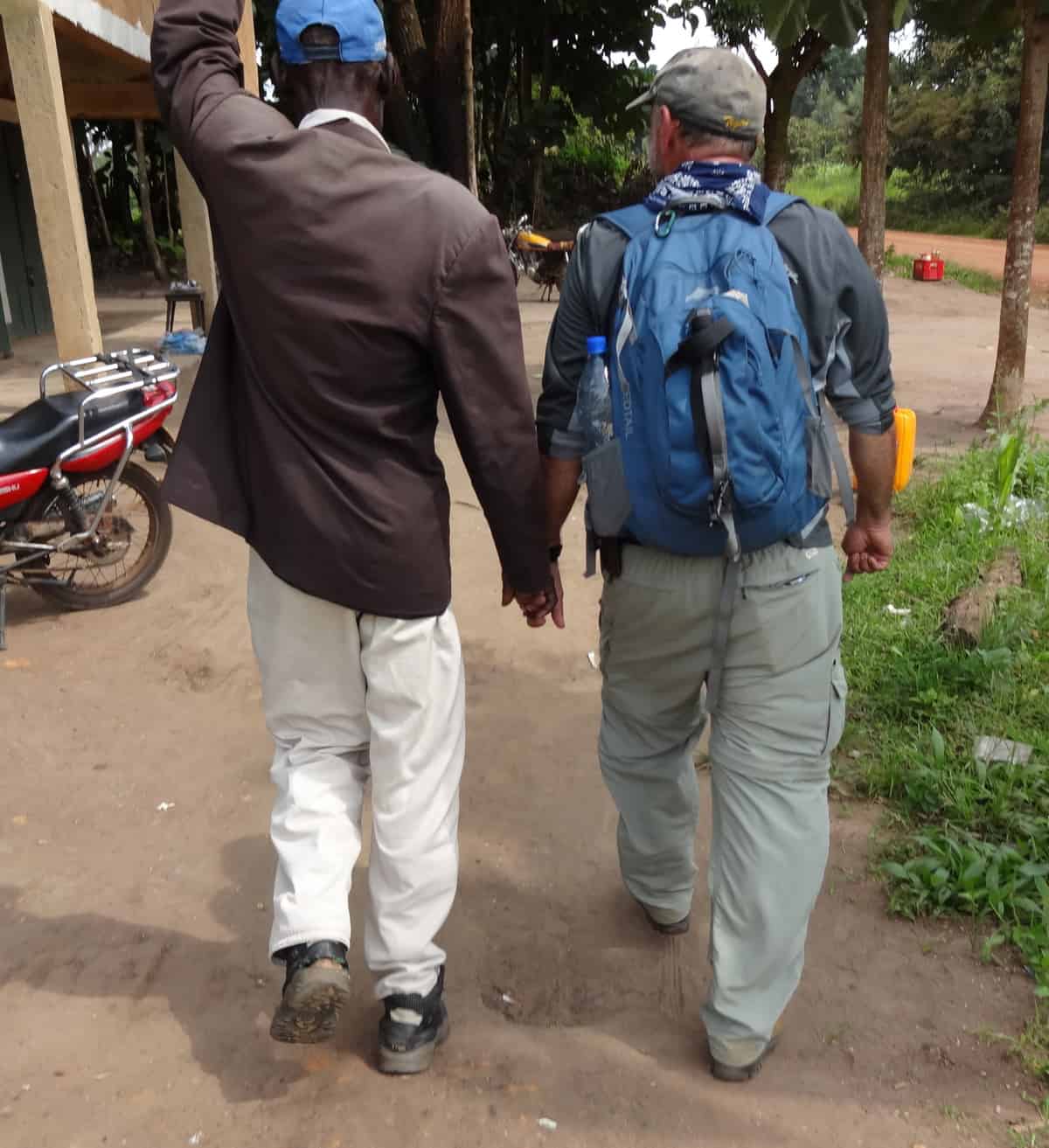
I can’ t get this poem off my mind. My life has been a succession of travel on the road less traveled. This New England poem takes me back to Africa. The Road Not Taken By Robert Frost. Two roads diverged in a yellow wood, And sorry I could not travel both And be one traveler, long I stood And looked down one as far as I could To where it bent in the undergrowth; Then took the other, as just as fair, And having perhaps the better claim, Because it was grassy and wanted wear; Though as for that the passing there Had worn them really about the same, And both that morning equally lay In leaves no step had trodden black. Oh, I kept the first for another day! Yet knowing how way leads on to way, I doubted if I should ever come back. I shall be telling this with a sigh Somewhere ages and ages hence: Two roads diverged in a wood, and I— I took the one less traveled by, And that has made all the difference. -Robert Frost You don’t have sell your things and go to Africa. to walk the road less traveled. The crossroads to the road less traveled appears every day in your life and mine. It’s the small things that lead us there. Happy walking. Curt In African culture it is proper to hold a man’s as you walk. This is a clear demonstration that this Mzungu (White Man) is accepted as a Mzee (Elder). My co-workers said I hold the world record for total steps holding hands with another man. It consider it a badge of honor.
Baptized in Muddy Water

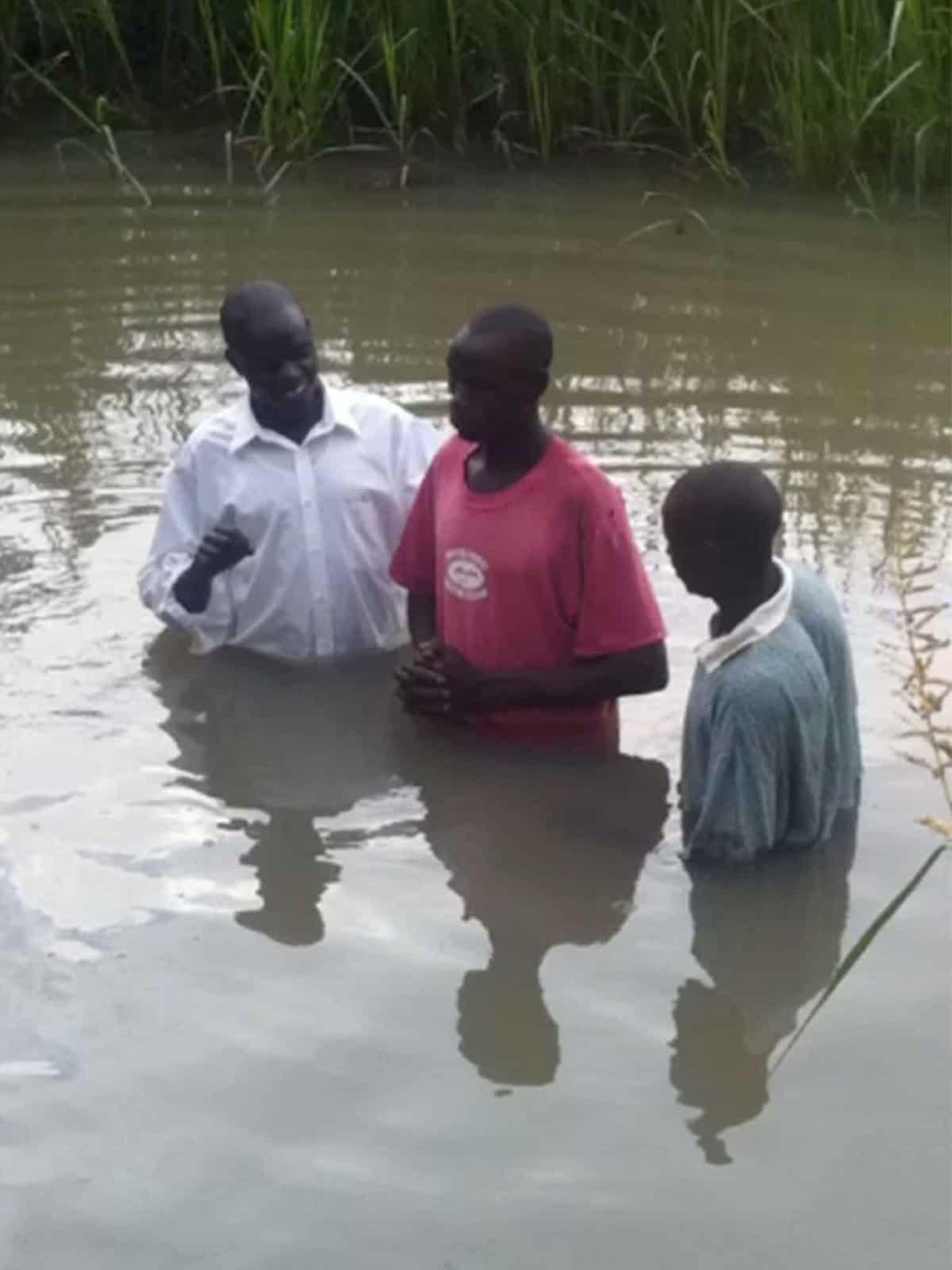
Immediately after Moses’ baptism, I jotted the outline of this story in Journal #73 This week, I’m Camp Missionary at Pineywoods Baptist Camp in Texas. The following is a story I related to the boys at camp. I hope you enjoy it as they did. BAPTIZED IN MUDDY WATER His name was Moses. And I witnessed his baptism. It wasn’t in the River Nile. But a muddy hole in Uganda’s Oya River. It’s not big enough to be a river where I come from. It was a rural baptism. In a real stream. How rural was it? I drove in and out to the site in four-wheel drive with the hubs locked. Moses’ Ugandan baptism was similar to Jesus’ baptism in the Jordan: Outdoors. In running water. With a crowd of curious onlookers. Even though the Holy Spirit didn’t come down in the visible form of a dove, God’s presence was very real. A knot of folks gathered at water’s edge for Moses’ baptism. Eleven fellow refugees who’d crowded into our Land Cruiser. All part of a preaching point at Lokujo Camp. A preaching point that is growing into a fledgling church. The refugees were joined at the Oya River by dozens of local villagers. Curious children. A few gawking adults. This is the heart of Muslim country. I’d like to know what these followers of Islam thought of the first baptism they’d seen. I told DeDe the onlookers wouldn’t have been more surprised if a UFO landed and green men came down the steps. Our church leaders explained, in Kakwa and English, what baptism is about. They explained that baptism does not bring salvation. It is a step (and a big one) on the road of obedience to follow Jesus. It’s symbolic—not salvation imparting—of the born-again process. The old man goes down into the water. He’s buried under the water. I guess you could infer that it pictures the drowning of the old man. A new man arises out of the water. A new person in Christ. On the riverbank, the women sing. Several scream the indescribable “African war whoop.” Another muddy water baptism: Bundick Creek Louisiana May 1922 Back home we would’ve sang “Shall We Gather at the River.” Today’s singing was, as it should be, all-African. Dozens of local children are crowded at the water’s edge as Pastor Mark shares about the born-again experience. Moses, a young man about age thirty, is nervous but determined. Ironically, he’s about the same age as Jesus was at his baptism. My heart hears the faint words of a favorite song, I have decided to follow Jesus. No turning back. No turning back. I glance at Mercy, a young nurse who is also a new believer. She has turned away from her family’s Islam to follow Isa, whom she and I believe to be the Son of God. No turning back. I’ll follow Him. The baptism ends. Moses and Pastor Mark change clothes. We all crowd into the truck and head back to Lokujo Church for the Lord’s Supper. It’ll be the first communion for this baby church. Plain, simple, and worshipful: Lokujo Preaching Point Moses’ first time to contemplate the bread and wine that symbolically represent the sacrifice of Jesus. Blood and Body. Juice and Bread. Once again, a symbolism that means so much to the Believer. A strong symbolism that always humbles and touches my soul. This do in remembrance of me. We roll the windows down. The AC is on the blink again. A light rain falls as we slip and slide along the red dirt road. I crank up the stereo. Casting Crowns with “My Life Song Sings to You.” The refugees, with their keen African ears, pick up the tune and hum or sing. Next up, I play “Come Thou Fount” by Chris Rice. The wipers swing to the song’s rhythm. My passengers know the tune and sing in Kakwa. I struggle along in English. Jesus sought me when a stranger Wandering from the fold of God, He to rescue me from danger Interposed his precious blood. I glance in the rear view mirror. At Moses. And Mercy. And Pastor Mark. James, my son in the Lord, who is the Timothy for this refugee camp. They ask me to play “Come Thou Fount” again. “Play it again, Sam.” I happily oblige. No one speaks as we manoeuver along the narrow path. It’s a holy moment. The smells and sights of Africa catch in the breeze: Wet Grass. Plowed Soil. Splashing mud. Sweaty bodies. African laughter. Waving children. Scurrying goats. A cow, chewing its cud, refusing to give right of way. I wonder if I’ll ever get today’s events out of my heart. I sure hope not.
A Harvest Moon on the Equator

A word from Curt Thanks to all of you who prayed, gave and sent DeDe, my sister Colleen, and me to Africa. We all feel our trips were God-ordained and made a difference for the Kingdom. Once again, thanks! Scroll down to read my latest story from Africa. Tidbits If you’re interested in our November #WriteYourBookNov18 Webinar, click here. My Uncle Bill Iles is currently having an art show at the prestigious Cole Pratt Gallery in New Orleans. The official opening is today (Sat. Oct. 6 from 6-9). I’d be so honored if you’re in the area and can drop by. Learn more here. Our latest novel, As the Crow Flies, is available in all formats. The best deal is the Kindle version for $2.99. Click here to order your ebook. I’ll be speaking at various venues in the coming weeks. Visit our Appearances and Bookstore web page to learn more. Pray for DeDe and I as we seek to be salt and light in our community, on our street, and in our jobs. Pray for Dee as she teaches at Prompt Succor and me as I serve as a chaplain at Roy O. Martin’s mills. Speaking of Crow, the entire “Westport Trilogy”, is on sale for $40. Click here to learn more. We’re still giving free downloads of our novel, A Good Place. Visit www.creekbank.net and click on the book image. ___________________________________________________________________________ A Harvest Moon On the Equator J, his daughter Ember, and I finish a day’s hard drive across Northern Uganda, coupled with a two-hour wait at the Nile River ferry. (It’s the one where you sign a form listing your next of kin. They’d added a new twist: you receive a postage stamp sized cardboard square with “Visa” scratched on it. No one ever asked to see it. I brought it home as a souvenir. After this full day, we’re ready for a hot meal, cold shower, and bed. However, Pastor Joseph flashes his famous smile when he meets us in Adjumani Town. “Mzee (Elder), we’ve prepared a party for your return.” You never say no to African hospitality. I always remind myself that anything these friends do to make us feel welcome is an act of sacrifice. We arrive just as the sun sets, but that’s not really accurate. The sun doesn’t set near the Equator, it just goes plop. One minute it’s daylight, then it’s past dusk. At the clan’s compound, we join a circle of men as the women laugh while cooking in the huts. In Joseph’s village, I’m never sure who is kin to whom. Everyone is a cousin, brother, or uncle. It often leads to the proverbial question, “Same mother. Same father?” Several chairs are empty. I ask for old Luka (who gave my grandson Luke a rooster on our last visit) and am told he has passed. An old-timer who is either Pastor Joseph’s uncle or father reminds me of the cushioned mat I gave him in 2014. “It really helped my broken collarbone.” I inform him that Mizz Cooter, who made the mat, is also now with the Lord. I can picture Old Luka and Mizz Cooter Willis being neighbors in Heaven, sharing a yard of chickens and sweet potatoes hills. The party, or “program” begins. Pastor Mark, Joseph’s brother, is the emcee and his face and teeth gleam in the darkness. A few solar-powered lights are used by the ladies, but we mainly sit in the dark, but it doesn’t matter. The warmth of fellowship and friendship provide all of the light needed. They’ve baked a tiered cake for us and give the top layer to Ember. We’re served a traditional meal of posho, groundnut sauce, rice, beans, and chicken. They’ve sacrificed to provide chicken for this crowd. I look for a fork or spoon, expecting to find neither. We use our fingers to sop up the food. It’s good. There aren’t many opportunities in life where you get to lick your fingers off this much without having your ears pulled by your grandma. Also, it takes a while to eat rice and beans with your fingerprints. Kind of like thick chopsticks. We sing. We worship. The ladies squeal their unique ovulation of joy. Every pastor there gives a sermon. I stare up into the night sky and find my three friends who’ve traveled this last month with me. Bright Venus, the evening star is setting in the west. Jupiter, a giant planet but much fainter follows its cousin setting toward the horizon. High in the sky sits Angry Mars. It’s at its reddest and brightest of my lifetime and I never tire of seeing it nightly. The rest of the night sky is mixed up as if someone took a stick and realigned the constellations. My northern hemisphere stars are not visible here. Only Venus, Jupiter, and Mars are familiar and I find solace knowing that although Louisiana is nearly eight thousand miles away, these planets will be in similar positions eight hours later back home. Our party/program/worship service comes to an end as we head to our bush vehicle. Ember cradles her round cake top under her arm as she climbs in beside her dad. Sara, a young African trained in trauma counseling, catches a ride with us, and the four of us head out toward the main road and the nearby town of Adjumani. As J turns east onto the road, we are stunned. A full moon, like no moon I’ve ever seen, is rising above the bush directly behind the road. I’m reminded it’s the autumnal equinox and this is a harvest moon. The old-timers named this moon due to its brightness and early rising extending the hours needed for harvest. The afterglow of our party, the darkness around us, make the huge yellow moon even more impressive. I’ll remember it until the day I die. I didn’t even bother to take a photo, knowing no image would do it justice. J turns
A Thought: Bricks Without Fire

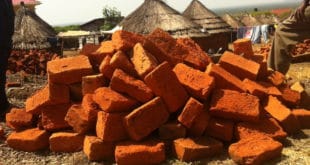
A word from Curt The Borderlands Team is compiling a devotional book for Refugees. The following is a short devo I wrote. I hope it blesses your life. Bricks without Fire Scripture: Daniel 3:24-25 24 Then King Nebuchadnezzar . . . declared to his counselors, “Did we not cast three men bound into the fire?” They answered and said to the king, “True, O king.” 25 He answered and said, “But I see four men unbound, walking in the midst of the fire, and they are not hurt; and the appearance of the fourth is like a son of the gods.” “The experience of what happens to a man is not as important as what the man does with the experience.” -A. Huxley I had not been to the refugee camp in three years. We were here to inspect the boreholes and visit the churches. I noticed that many tukuls (huts) were gone. There was no trace of their prior existence. I asked our local pastor, “Where are the huts that stood here?” “They were made of mud bricks that melted away when the rains came. They had not been fired.” I thought about the three heroes of the Old Testament, Shadrach, Meschach, and Abednego, who were tossed into the fire by the evil king, yet were protected by our strong God. Many of you as refugees have been through the fire of war, famine, death, and loss of all you owned. However, you’ve come through it as bricks that have been fired. Your lives are now made solid and hard by the grace of God in the fire. As the rains of being a refugee fall, you do not melt away. You remain strong. It is God that makes you strong in the fire. As the evil king says in one translation, as he saw the three men standing in the fire, “I see a fourth man and he appears as the Son of God.” Jesus still stands by us in the fire, and the result of the fire is a stronger testimony and life. Prayer: “Lord Jesus, thank you for never forsaking me in the fire or rain. Thank you for the strength from the fire to face whatever comes my way. Help me to lean on you. In Jesus’ name. Amen.
New Life and Death: On the Refugee Rollercoaster

Hotel cleaning lady in Entebbe. On my arrival, I was badly jet-lagged. She came to me, “Bwana, your shirt is on backwards.” This is after I changed it correctly. I thanked her New Life and Death: On the Refugee Camp Rollercoaster Sometimes I write because I want to. Other times, it’s because I have to. Today is probably a split decision on the two. I had a dream come true today. I went to church at Rhino Camp. Rhino is a secluded refugee camp housing a quarter million South Sudanese refugees. Let me emphasize that number: 250,000 souls. My wife, DeDe, and I had visited Rhino Camp, which supposedly got its name when Teddy Roosevelt bagged a rhinoceros there on one of his famous safari trips, several times in 2014 and 15. It was a small camp of several thousand, most Nuer tribe refugees, who’d fled the war in South Sudanese. We’d had a dream to see local pastors plant churches among these needy people, but it was not to be on our watch. Then, yesterday I attended Ocea Baptist Church, a vibrant congregation comprised of forty adults and thirty precocious children. The service, a combination of English and Arabic, was simply wonderful. Joyous singing, heartfelt testimonies, two offerings, and several sermons. I only wished DeDe was beside me to witness a mud-walled, thatched church of forty adults, including many of them men. Ocea Church is comprised of various tribes across the South Sudanese spectrum, but I was most thrilled that much of the congregation are Muslim Background Believers (MBBs) from Darfur and the Nuba Mountains, both areas of the Republic of Sudan. The long service drew to a close and our group, led by missionaries Jeremy and Susan Taliaferro, retired to the shade of a mango tree, awaiting our obligatory tea and snack. It’s part of the culture and it involves a long time of sitting awaiting their show of guest hospitality. It was at that moment when our entire day changed. We were needed at the nearby hospital where a small boy had died. Jeremy and I loaded in his Toyota truck and with a bed full of church members, traveled the 2 km to the hospital. The young two-year-old boy had arrived in Rhino Camp only two days ago. Whatever his illness, coupled with the harsh travel refugees face, it had taken his life. The nurses tenderly removed a covering sheet, revealing the small shroud-wrapped child’s body. It simply broke my heart. I’ve seen death up close, but the sight of this shrouded child brought out emotions I cannot fully describe. Sympathy for the mother who had recently lost her husband and buried another son. Her remaining two daughters stood wailing beside their brother’s body. The mother, a look of shock on her face, stood stoically beside them. Another emotion flooded me. Anger. Anger at war. Just as sure as a bullet or land mine, the South Sudanese Civil War had claimed another victim. The body of the boy was placed on a stretcher and carried by the young men of our church to the grave site in the corner of a weed-filled field. He was placed beside a child-sized open grave. A host of Dinka women accompanied the mother, all dressed in the colorful dresses and head scarves that identify their tribe. They began softly singing what I will always call the burial song. Jeremy commented that with this family’s recent arrival, these women weren’t close friends. They’d simply come to comfort. I wondered how many of them had also buried a child in some foreign field, hundreds of miles from their homeland. An Anglican pastor preached a wonderful sermon. He used the Biblical story of the widow Naomi, a refugee from famine-stricken Israel, who incurs great sorrow in burying two sons of her own. When she finally returns to her homeland, her faithful but barren daughter-in-law, Ruth, insists on staying with her, speaking the memorable sentence, “Wherever thou goest, I will go . . .” that has been a part of dozens of weddings I’ve attended in America. But today is not a wedding. It’s a burial. The pastor tenderly reminds us all that God brought good out of Naomi’s and Ruth’s tragic life. “Ruth marries a man named Boaz, and she is the great-grandmother of the future King David,” he says. “Most importantly, Ruth is also a direct ancestor of our Savior, Jesus Christ.” South Sudanese are fastidious in tracing their lineage back for generations, so the Pastor’s words resonate with the crowd around the grave. Pastor motions toward the small grave. “We Sudanese have had so much sorrow, but like Ruth, God can bring good from even our tragedies and troubles.” He points to the grieving mother. “This family each had a faith in Jesus. Mother, you must believe you’ll see them again. In the meantime, like Naomi and Ruth, you must go on.” Next, the most touching part of this event Jeremy and I are witnessing occurs. The pastor and Ocea church’s pastor, Brother Mula, take off their shoes and lower themselves into the grave. The shrouded body is tenderly passed to them as the mother quietly stands at the head of the grave. The two pastors begin a careful ritual of covering the body, first with sticks, then mud, and finally the young men of our church, began shoveling the dirt until the grave is mounded. They carefully tamp down the top of the mound with the backs of their shovels and drive two sticks into the ground at the head of the grave. When Pastor Mula climbs out of the grave, his blue dress shirt is sweat-soaked and sticks to his body. His hands, legs, and feet are mud-covered. But today, they’ve been the very hands and feet of Jesus. I’ve never seen a more visual representation of the
Getting ready to teach on Tuesday. Here’s how to pray!

I began teaching at Uganda Baptist Seminary Today on Tuesday, Sept. 11. (We’re 8 hours ahead of CDT). It’s been a rough, tough, adventurous journey to get here, but I’m ready to do what I came to do: teach the Book of Acts and Paul’s Letters to an eager group of pastors who traveled from all over East Africa to grow and learn. Pray for: Clarity in my speaking and English. That’ll I’ll keep it simple and Scripture-centered. Open ears and hearts from the students. That’ll I’ll invest in their lives as I teach. That I’ll get proper rest. I’m still fighting jet lag and exhaustion. (I’m writing this wide awake at 2 am!) I close with a story: William Tyndale, the great translator of the Bible into English was told by a church Bishop to stop his work. “The Bible we have (Latin and Greek) is all we need, and it’s against the law to put the Bible into common English.” Tyndale, who was martyred in 1536 for his English translation, told the Bishop, “If God lets me live, I’ll produce a Bible where the common English ploughboy will know more of the scriptures than you.” Tyndale paid with his life. His dying words were, “Lord, open the eyes of the King of England.” That prayer was answered in 1611 when King James assembled scholars to produce an official English Bible. They drew heavily from Tyndale’s translation. We know it as the King James Version (KJV). As I teach rural pastors today, many of who still push the plow in their cassava and maize fields, I want to teach the Word faithfully. Pray for them as they return in six weeks to churches and villages to teach the Word to other ploughboys (and ploughgirls). What a privilege. Pray for us! Curt As I have internet, I’ll be posting at Facebook and Twitter (@curtiles).
You can help with our September Africa Trip!

DeDe and I are excited . . . and somewhat nervous. We will both return to Africa in September to be part of what God is doing in Uganda, Kenya, South Sudan, and beyond. This will be our first trip back since leaving in 2015. It is a great opportunity for us to be part of the fresh work God is doing among the people groups we grew to love deeply as we worked with them. Here’s how you can hold the rope as we go: Pray now. Pray fervently during September. As God leads, give to help with our travel expenses and distribution of Bible story cloths and Audio Bibles. You can give by sending a check (see address below) or using your credit card at our Open Hands Missions Go Fund Me account. DeDe’s trip will be during the first two weeks of September. DeDe and my sister, Colleen Glaser, will travel to Kenya with our former co-workers David and Renee Crane, who now serve with Calvary Road Ministries. They will be part of a small team traveling to northern Kenya and the sprawling Kakuma Refugee Camp. God is working among two South Sudanese refugee camp people groups, the Nuer and Anuak people. We were privileged to build relationships with churches, pastors, and leaders of these groups during our three-year African sojourn. The Kenyan team will be teaching Bible storying to the women in the camps. It will be a ripple effect that can spread beyond these two people groups to the over 100,000 refugees in Kakuma who are natives of Somalia and Ethiopia. Faith comes by hearing, and hearing by the Word of God. Romans 10:17 I (Curt) had already committed to a trip I feel strongly about. As the Lord stirred my heart to return to Africa earlier this year, I prayed about how I could be the best steward of time, ministry, and money/resources on a month-long trip in September. I’ll spend two weeks at our wonderful Uganda Baptist Seminary (UBS) in Jinja, Uganda teaching the book of Acts. My co-learners (I’ll learn as much from my students as they learn from me!) will come from seven African countries. From my prior association with UBS, I’m aware that many will have traveled through war zones, left their crops and families, and sacrificed greatly to attend seminary. It will be one of the privileges of my life to teach from the mission book of Acts and live and learn among these pastors and church leaders. I’m excited and humbled that the ripple effect from teaching God’s word can, and will, spread back across a wide swath of the Continent. After I complete my teaching assignment, I will travel to northern Uganda to visit our pastors, churches, and fellow missionaries along the South Sudanese border. Sadly, the war in South Sudan has continued and most of the civilian population have crossed into the border countries. In fact, the International Mission Board team we will work with, the Borderlands Team, is tasked with bringing the gospel to the hundreds of thousands who continue to pour into Uganda. I’ll visit churches that began under U.N. tarps and mango trees beside water wells we drilled by our organization. Many of these refugee churches have multiplied. I cannot wait to see with my eyes and heart what God is doing among the Kakwa, Madi, Murle, Dinka and other South Sudanese people groups now residing in Uganda. After ten days in the camps, I’ll return to the U.S. on September 30. As funds allow, we will distribute two items to churches in both Kenya and Uganda: Solar-powered Bible Audio players in the heart languages of the refugees. These cost about $60 each and are extremely effective in spreading the Gospel. Two types of Bible story cloths: the original forty-two picture cloth plus a new story cloth depicting the book of Acts. They cost $8.00 each. Additionally, we are asking for help on transportation. My Ugandan ticket has been paid, and I plan to travel in-country by bus and matatu (small bus taxies). DeDe and Colleen will need two tickets: from America to Nairobi, Kenya (about $1000 each) and a Mission Aviation Fellowship bush plane ticket from Nairobi to Kakuma Camp ($400 each). Any additional funds we receive will be used to buy story cloths, audio Bibles, and incidentals such as required immunizations and in-country expenses. All gifts will be funneled through Open Hands Missions, a 501 (c) 3 organization* we formed for missions in Africa. Your gifts will be tax-deductible and we will keep you posted on how monies are spent. As God leads, you can give by: Checks made payable to “Open Hands Africa” and sent to P.O. Box 6060 Alexandria, LA 71307. For your convenience, we’ve set up an Open Hands Missions Go Fund Me account if you prefer to give via credit card. Most of all, we need you and your church to hold the rope in prayer. We return to Africa fully aware of the challenges and obstacles we’ll face. We won’t go without your prayer support. Our plan is to make use of Facebook and our blog (www.creekbank.net) to keep you prayerfully informed. Thank you for allowing us to share about our September trip. Through your prayer and giving, you’ll be there with us. Gratefully, Curt and DeDe Iles *Open Hands Missions IRS 501 (c) 3 # 46-1138573 PO Box 6060 Alexandria, LA 71307 dede_iles@gmail.com/curt@creekbank.net 318.623.3778