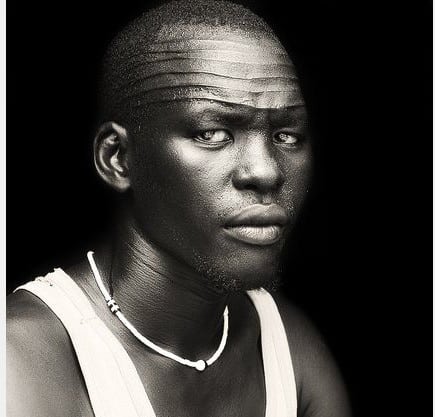
“. . . It doesn’t mean you’ve been discarded.”

A lonely boy named James. So take that look out of here, it doesn’t fit you. Because it’s happened doesn’t mean you’ve been discarded. Pull up your head off the floor, come up screaming. Cry out for everything you ever might have wanted. -“In a Big Country” * *Complete lyrics at end of post “I found him out here sleeping on the ground. He had no one.” I glanced from the narrator to the young boy. He was maybe ten or eleven. “His name is James.” Peter, the narrator, swung his arm around the camp. “He’s the only Anuak in the entire refugee camp.” I thought of how far it is from the home of the Anuak people along the Ethiopian border to this area of NW Uganda. How did the boy get here? Does he even know? Peter, a Dinka Bor, said, “My family took him in. I don’t know how he got here or what happened to his parents, but he’s with us now.” We’d only met Peter thirty minutes ago but already I’d formed an opinion. He is a man of peace. A leader of the current refugees at the border camp. I don’t think it’s too much to suspect he might really be an angel. People who take in strangers in the midst of their own troubles certainly are angelic in my humble opinion. I grinned at the irony. Everyone warns us, “Stay away from those Dinka. They’re bad people.” I’ve found that each tribe has angels. Sadly, the unraveling of our country has also shown each tribe has demons and agents of hate. I’ve decided to identify and chronicle the angels around us. They don’t make the BBC News but have the better stories to share. Last week, I visited in another Angel Home. Pastor John is Murle (another South Sudan tribe). As I visited his temporary home in Entebbe, he introduced his own four children, then his three nephews/nieces living with him. “We still don’t know where their parents are.” Next he pointed out three more children, “These were the children of my best friend. When he and their mother were killed, we took them in.” Angels. Murle John is another angel. Among the Murle, a tribe with a fearsome reputation among their neighbors. After spending two weeks with American pastor Tim Lee, I was reminded of two Louisiana angels I’ve always loved, R.L. and Margie “Cooter” Willis. These residents of Ten Mile Community raised over four hundred foster children including Tim. Yep, an angel can even be named Cooter. It’s right up there with Clarence Oddbody ACS (Angel Second Class). Angels around us. Peter and his family plus Anuak James have probably arrived at Rhino Camp, the refugee camp on the west side of the Nile, or maybe the larger Adjumani camp across the River. When I visit the camps this week, I’m going to find them. Don’t tell me I can’t do it. I’ve got their full names and am determined to follow their story. I’m going to visit with the lonely Anuak boy who has been rescued by a Dinka Bor angel named Peter. Lyrics “In a Big Country”: I’ve never seen you look like this without a reason, Another promise fallen through, another season passes by you. I never took the smile away from anybody’s face And that’s a desperate way to look for someone who is still a child. CHORUS: And in a big country, dreams stay with you, Like a lover’s voice, fires the mountainside.. Stay alive.. (I thought that pain and truth were things that really mattered But you can’t stay here with every single hope you had shattered) I’m not expecting to grow flowers in the desert, But I can live and breathe and see the sun in wintertime.. CHORUS [x2] So take that look out of here, it doesn’t fit you. Because it’s happened doesn’t mean you’ve been discarded. Pull up your head off the floor, come up screaming. Cry out for everything you ever might have wanted. I thought that pain and truth were things that really mattered But you can’t stay here with every single hope you had shattered. I’m not expecting to grow flowers in the desert, But I can live and breathe and see the sun in wintertime..
Saturday Snips: Thoughts from a “Soul Retreat”

Last week I took a Soul Retreat. I got on a crowded fishing boat and traveled to one of the islands on Lake Victoria. It was a time for reflection, renewal, and writing. In upcoming blog posts, you’ll find many of the stories I wrote. They are simply from my heart to yours. Enjoy! It’s a long way from Choupique to Nimule. Chances are I’m one of the few people who knows where both Nimule and Choupique are. Bubba Hoezler does. He’s from Choupique, Louisiana. And he has a new Polaris Ranger waiting for him in Nimule, South Sudan. I first met Bubba and his wife, Cathy, in the Nairobi (Kenya) Airport. I was one of three Louisiana men enduring a seven-hour layover. Bubba came over. “Y’all sound like you’re from the South.” “So do you.” He smiled. “Where are you from?” “Louisiana.” “Well, so am I.” “What part?” (This is the part of the game that every Louisianan dreads. Any conversation will mention sooner or later mention New Orleans (which we don’t always care for).[MU2] “Near Lake Charles.” “Really?” “Do you know where Sulphur is?” “Sure.” “I bet you’ve never heard of Choupique?” I surprised him. “I know exactly where it’s at. I preached at Choupique Baptist a few months ago.” He slapped my shoulder. “My daddy leads the singing there.” That was my introduction to Bubba and Cathy Hoezler. We enjoyed their company all the way to Houston Airport. They worked in Sudan and hadn’t been home in five years. I helped eased their reentry into culture with Jerry Clower stories on my iPhone. I remember Bubba’s comment as he bought an airport coffee. “I can’t remember the last time I handled paper money. Last week, I traded a bucket of nails for a jerry can of diesel.” Strangely, I’ve not seen them since. Bubba and Cathy Hoezler But I keep up with them through the Internet and mutual friends. They work for a wonderful sister organisation. Cathy is a P.A. and runs a clinic in one of the large refugee camps on the Sudan/South Sudan borders. Bubba is an oil field hand who can work on anything. That comes in pretty handy in Africa. A few months ago I followed the difficulty Bubba and Cathy were having getting a new vehicle into South Sudan. Not just any vehicle. A new Polaris Ranger 4WD. You may not be cultured enough to know about the class of 4WD vehicles known as “Off Road 4WD Personal Vehicles.” They’re a cross between a 4 wheeler and truck. There’s the John Deere Gator. The Kawasaki Mule And the Polaris. You may not believe it, but I know men that would trade their wife for one of those rigs. It’s a woods running/deer hunting/off road machine. With South Sudan’s rainy season approaching and knowing the narrow trails winding throughout refugee camps, I could just imagine their Polaris allowing Bubba and Cathy’s to get to inaccessible locations for their Jesus-work. It’s made or getting in and out of tough places. The problem was that Bubba and Cathy couldn’t get their Polaris out of a really tough place: South Sudan customs at the Nimule border. Vehicle importation is a headache in this part of Africa. Customs fees, import taxes, and open palms can jack the price up to nearly double the original price. Customs at Nimule was demanding thousands of dollars to import the Polaris. It sat for weeks at the border. I sent an email urging Bubba to link up with one of my friends with Far Reach Ministries or FRM as it is called. FRM trains chaplains for the South Sudanese Army or SPLA. It’s a great ministry operated by Americans Wes and Vicky Bentley since 1999. I never heard about the Polaris again. Mid-December brought war to South Sudan and the mass displacement of hundreds of thousands. Including Bubba and Cathy. They were forced to leave their refugee camp work due to the instability. They landed in Nairobi and like all of us, waited for the smoke to clear. Last week, our team was in Nimule. We stayed at Far Reach Ministries. In the parking lot, sat a brand new __ Polaris. I’ll admit to breaking the Ten Commandments. I coveted it. As my friend Gary Marler would say, “I wished it belonged to me and the owners had another one just like it.” Seriously, I knew who the owners were. It was Bubba and Cathy’s. Waiting to make its trip up north to Dori Refugee Camp. I was reminded of God’s timing. If the Polaris had made the journey as planned, it probably wouldn’t be stolen or looted after our folks left. I saw on Facebook that Bubba and Cathy have made an exploratory trip back to Dori Camp in unstable Upper Nile. Lord willing, they will be back home. And that Polaris will have made its journey from Choupique to Sulphur to Mombasa to Nairobi to Kampala to Nimule. And finally to its use for optimum use in Upper Nile, South Sudan. I hope it’s not a sin to pray for a vehicle. I’m not talking about praying to have a Polaris. (Although that is a thought.) I’m referring to praying for a vehicle as in, “Lord, take this Polaris and get it to Upper Nile state. Take it and use it for your glory. As Cathy practices her healing ministry. As Bubba works on water wells and faulty carburetors. Thanks for the folks back home Who sacrificed to provide this 4WD. Keep the Polaris safe. Keep our friends healthy and safe. Bring your peace to all of South Sudan. May this rig be a vehicle of your love. May it carry the Gospel to the white fertile fields of the Camps. In Jesus’ name. Amen. P.S. Lord: Long may it run. Long may it run. Follow the Hoezler’s work at http://www.hopeforeverynation.com Learn more about Far Reaching Ministries and it’s work in supplying Chaplains to the South
The Day Indy Died

The Day Indy Died His name was Independence Moses Nono. A new child born on the new country’s first day. The first child born at a Juba hospital shortly after midnight. July 9, 2011 All full of hope and promise. His parents, Moses and Josephine Nono gave him the full name of Moses Independence. The mother shared in news reports of her high hopes for both her new son and the new country. In fact, many South Sudanese refer to their nations as “New Sudan.” Independence was the first new baby in New Sudan. A fresh start. A new beginning. Sadly, two and a half years later, fighting has broken out in New Sudan. A tenuous ceasefire has stopped the fighting. The future is uncertain. Baby Independence’s story is even sadder. He died before his first birthday. The details are sketchy. He became ill, got sicker, and the doctors and hosptials couldn’t help him. Less than seven months after the birth of this special baby, he was dead. “I was so very happy. I even took the flag and put it on my house to show the neighbors,” says Moses of the day they brought Independence Moses to his home on the outskirts of the capital. “But God just took it down, and all that happiness went,” he says. Baby Independence will never see his country grow into a true land of freedom and peace. It shouldn’t surprise us. Infant mortality is high. A man or woman of age 60 is considered old. That’s about the expected life expectancy here. Sadly, the events occurring now will only bring that age number lower. That’s what war, poverty, and famine do to the health of a nation. In Africa, the stats of those dying in war zones are not limited to mortars and machine guns. Many more die from malnutrition, opportunistic diseases, and famine. Dead is dead. It doesn’t have to be a bullet. Since the December (2013) fighting broke out between the rebels and government, many have written the obituary of New Sudan. “If they can’t get along for no more than two years, what hope is there for this country.” They fought the Arab north, thousands died to bring this opportunity to become a new free nation, and now the selfishness of power-hungry leaders, has resulted in prediction of continued war. My home country, America, is known as the “Midwife of South Sudan.” Our government and aid organisations worked hard to broker the peace deal in 2006. The United States has poured tens of millions of dollars into South Sudan. America the Midwife is now watching its baby on life support. Probably like the midwives who delivered Baby Moses Independence felt as sickness took his life. Helpless. Wondering what went wrong. What could we’ve have done different. South Sudan is on life support but where there is breath, there is life. Her breathing is shallow and fitful. But she’s alive. David Deng, the son of a Dinka chief and American mother, said it well, “If you’re not an optimist, you have no business being in South Sudan.” Things can change. Things can get better. Even if Africa seems cursed, things can turn around. It won’t happen overnight and it won’t be easy. Progress is seldom easy nor free. I come from the rural South, the state of Louisiana My homeland was probably the last part of America to move beyond the scourges that hold people back. In the latter nineteenth century, malaria, yellow fever, measles, and smallpox killed people. Infant mortality was high. This was brought home to me one day at the oldest part of Dry Creek Cemetery. Mr. Frank Miller pointed at the weathered headstones. “Look how every big tomstone is surrounded by small ones.” He shook his head. “Most of the old timers buried at least one child. Some buried many.” He then directed me to a headstone. “She died in childbirth. That was all too common.” I thought about Mr. Frank’s words when a African researcher said, “In parts of South Sudan, women still view pregnancy as a possible terminal condition. They know some will not survive.” * * * South Sudan has a long list of problems and challenges to overcome. The recent conflict has set this back. But there’s still life. And hope. There’s a belief (held by those optimists like our Chadan team) that things can and will improve. I believe it’s through changed hearts and minds that the nation will step beyond despair. Without apology, I believe hearts and minds are only changed by the Spirit of God coming into a person. That’s why we forge ahead. As another tough optimist/jailbird named Paul said, “Forgetting the past and striving for the future . . . ” I can honestly say that there’s no part of the world I feel that we can make a difference more than in South Sudan. We cannot take our hands off the plow. We will not look back. The way forward is the only way to go. [gravityform id=5 title=false description=false ajax=true tabindex=49] Read more on Baby Independence and our country of South Sudan: http://www.unicef.org/southsudan/10904_13026.html http://www.unicef.org/southsudan/reallives_birth_of_a_new_nation.html http://www.mirror.co.uk/news/world-news/south-sudan-one-year-on-864311 Evergreen Cedar in Dry Creek Cemetery Louisiana Both Sides Now So many of our American experiences take me back to Louisiana. I call it “Both Sides Now.” Thinking of home makes me smile and sometimes brings tears. But I’m always thankful for my roots back home. At the same time, DeDe and I feel so blessed to be where God is working in our “New Home” of Africa. Yes, we’ve looked at life from both sides now. Read about our beloved Dry Creek Cemetery and its iconic tree in “An Evergreen Cedar Tree.”
How to Survive a “I Hate Africa Day”

Welcome to the Creekbank Blog. We’re glad you’ve stopped by for a visit. If you have comments or questions, please use the form at the end of this blog post. How to survive a “I Hate Africa Day” “In the end, our Call is to Him. Everything else is just geography.” Is it a sin to have a “I Hate Africa Day”? I sure hope not. Because from time to time I don’t love Africa. There are some days when I’d rather be back at The Old House in Dry Creek. Back among the familiar and family touchstones of my fifty-seven years. I’ll admit it: There are times and days when I hate Africa. Recently I had an “I hate Africa Day.” We were in northern Uganda. A long emotional day in a huge refugee camp. I’m not a picky eater but the supper that night featured a piece of chicken that was as tough as it was raw. I left hungry. The better lodging in the town was filled by UN and Aid workers. We stayed at a cheap guesthouse that was cheap for a reason. The rain really broke loose just as we lugged our packs in. My rain gear was in the bottom of a box in the back of the Land Cruiser. My partner Bob described the rain as a “frog choker.” Not to be outdone, I described it as a “log floater.” It nearly quailified for my personal favorite, “Raining bull heifers and enough hay to feed them.” (Thanks Emil Turner) By the time DeDe and I got to the porch, we were soaked. The guesthouse wasn’t clean. In honor of the bathroom, I nicknamed it the “Sticky Floor Hotel.” Bob swore it operated part-time as a brothel. There was no hot water. Didn’t expect it. Electricity was spotty. Just like I expected. Under the mosquito net, it was stifling. Being hot or skeeter bit has no good options. I was Wet. Tired. Hungry. And Hot. Not a good combination. I didn’t handle it well. The situation had gotten my goat. My bucket was full. And I was ready to dump it. I was unhappy. And I was ashamed. We’d just left thousands of South Sudanese who had no shelter from the storm. I had a roof over my head and a bed to lie on. We’d watched a long line of pail-carrying women waiting for food. An equally snaky line of yellow jerry cans and tall thin Dinka ladies. Laying on the bed with the pattering rain on the tin roof I was angry. Mainly angry at myself for not being grateful or even slightly spiritual. I’m embarrassed to even tell you what a bad sport I was. My wife, who is an angel, just gave me as much space as our cramped room had. I’m not happy about it, but I was having a I Hate Africa Day (or NIght in this case.) I thought about Ol’ Paul and Silas in the Philippi jail. Singing at midnight. Then Shipwrecked Paul. He was cold. tired. wet. and hungry. Built a fire to dry out and got a snake bite. That’s reason for a full-fledged I-Hate-The-Mediterranean-Day (or Month.) Yet Paul used the occasion to share the Gospel and heal folks. I was more like Elijah after the Mt. Carmel episode. I was hunting a cave to hide in for a few days (or weeks.) But the sun came up the next morning. I got out and made a pot of fresh coffee on our camping stove. A group of children came through the parking lot picking up peanut-sized pods that had fallen from a large tree. They reminded me of a flock of geese foraging over a rice field. The children held up a bucket of the pods. “Porridge for breakfast.” As the coffee water boiled, I began humming an old song, “Picking up PawPaw/Putting them in your pocket.” For the moment, I was back in love with Africa. 5 Take aways on a “I Hate Africa Day.” 1. Those days and moments when come. 2. Those times will pass. 3. We should expect them, but not wallow in them. 4. These times will hit us hardest when we are tired, wet, hungry, and hot/cold. 5. In times like these, we must go back to Our Call. As a young missionary aptly said, “In the end, our Call is to Him. Everything else is just geography.” Amen and Amen.
Saturday Snips: Where is the “Danged Ol’ Dang”?

It’s Saturday and we’re sharing stories, snapshots, and snippets of the past weeks. Enjoy! If you have comments or questions, please use the form at the end of this blog post. We love hearing from our friends. Where’s the Danged Ol’ Dang? “When two elephants fight, the grass gets trampled.” -African Proverb It’s called “The Dang.” You’ve probably never heard of it. I hadn’t either until last July. It was at a Sudan conference hosted by the Rift Valley Institute, a think tank that specializes in African issues. I was at a resort in Jinja (Uganda) among diplomats, United Nations workers, and NGOs from various acronyms that always twists my tongue. The first night of the conference featured a trivia contest. They flashed a photo of a large South Sudanese (i.e. very black) man triumphantly hoisting a stick in the air as others in the photo exulted. The man holding the stick was Riek Machar. I knew it immediately. He has a Leon Spinks-quality gap between his two front teeth. The trivia question was “What is Dr. Riek Machar holding in his hand and how is it important in South Sudanese Nuer history?’ It was my first introduction to the stick known as “The Dang.” In the photo of Machar and the Dang, a middle-aged white man stood beside Machar. It was my first time to meet Douglas Johnson.
Colonel Sanders arrives in Adjumani

Welcome to the Creekbank Blog. We’re in Africa where “the stars are not familiar.”* We’re glad you’ve stopped by for a visit. If you have comments or questions, please use the form at the end of this blog post. (Africa is a long way from home and your feedback is encouraging.) COLONEL SANDERS COMES TO ADJUMANI It’s the land of the chicken. Or in this case, the rooster. The crisis (one of my Dinka friends calls it “The Incident”) in South Sudan has occupied our hearts and much of our writing over the last month. It’s time to take a break from the serious. Today, I’d like to tackle one of my favorite humorous subjects: chickens. When you travel in our part of Africa, you’ll eat lots of chicken (or as many languages call it, ‘kuku.”) The average African doesn’t eat chicken very often. It’s a luxury they reserve for special guests or events. We stayed in an African home where they sent money with a motorcycle taxi to purchase and bring back a live chicken. DeDe watched the eight year old daughter dispatch the chicken with a flick of the knife. On rural roads, schoolboy salesmen will run into the roadway holding aloft a flapping chicken in each hand. On trips “Up Country” we often eat chicken daily, sometimes twice in a day. (Fried, then stewed.) I call it “death by Kuku.” Last week we drove through Adjumani, Uganda. It’s the home of the Madi people and currently where thousands of South Sudanese are staying. Adjumani is a small town but has one large roundabout. Roundabouts. Anyone driving in East Africa comes to learn about roundabouts. They’re a holdover from the British colonial days. You enter roundabouts on the left side (UK driving standards) and take one of the exits. We name them 9 o’clock (first left) noon (straight through) and 3 o’clock (third exit). Some roundabouts have less (3) or more (5) decision points. I’m not quite sure what protocol is on entering a roundabout. We’re told that traffic already in the circle has precedence, but boda bodas (motorcycles) and matatus (Van taxis) haven’t gotten the memo. I’ve found you simply enter the roundabout in a steady speed and watch your side view mirrors and ease along. It calls for a combination of bluff, courtesy, and confident courage. South Sudan’s roundabouts are different. First of all, you drive on the right. (I love crossing the bridge at Nimule from Uganda into South Sudan. On the bridge, drivers swap sides in a choreographed ballet to their new countries). Secondly, SS law (or at least recommended) is that you turn on your hazard flashers entering the roundabout. Residents claim this creates more accidents when drivers see only one of the flashers and think you’re turning. As we say, TIA. This is Africa. Most larger towns have a clock tower in the median middle of their roundabout. (One of my friends who works with street kids says these medians are where the kids sleep as groups for safety.) Smaller towns will have a large tree as their roundabout median. Many times a tattered tractor trailer tire will serve as the center of the roundabout. But Adjumani has a large statue of a chicken. It’s actually a rooster. He’s large. I especially like the umbrella above Mr. Rooster. A Madi resident told us that the rooster is the symbol of their tribe and Adjumani, their main city. “It’s our time piece. We wake up when the rooster crows. Other towns have their clock towers that chime the time. We have our roosters.” That brought my twisted mind to one of my favorite twisted cartoons, The Far Side. I love Gary Larsen’s humor, especially his skill at giving animals human-like qualities.* Colonel Sanders arriving at the Pearly Gates is one of my favorites. The Adjumani rooster made me think of the chickens on each column at the pearly gates. Larsen’s Far Sides from his trip(s) to Africa are great. I laugh each time as I recall them. Do you have a twisted mind? If so, what are your favourite Far Side cartoons? Please comment below. Over the next few days I’ll be pinning my favourite Far Sides to our Pinterest page. Join in the fun. Comments section [contact-form subject=’A message to Curt at the Creekbank’][contact-field label=’Name’ type=’name’/][contact-field label=’Email’ type=’email’ required=’1’/][contact-field label=’Comment’ type=’textarea’ required=’1’/][/contact-form] How to contact us: Email: creekbank.stories@gmail.com Post: PO Box 332 Dry Creek, LA 70637 Facebook/Pinterest/Twitter: curtiles
Displaced: Sheriff Bishop’s Sidearm

Armed and Ready It’s odd that I’ve been thinking of Sheriff Bolivar Bishop here in Africa. We’ve been immersed in refugee matters for the past months. Hundreds of thousands of South Sudanese have been on the move due to fighting within the country between government forces and defected military units. Recently, a Louisiana group of pastors from my home parish of Beauregard visited in the refugee camps. Another group from Dry Creek is coming in a few weeks. Our team leader, Bob Calvert, made an insightful statement, “You Louisiana folks know all about what it’s like to be displaced. Through your hurricanes, you’ve learned how to help folks as well as receive assistance.” Bob’s correct. We know from experience what it’s like. In SW Louisiana, time is divided between “Before the storm” and “after it.” We all go back to 2005. There were two storms. Big sister Katrina as well as her lesser known but equally destructive younger sibling, Rita. Both hurricanes affected our corner of Louisiana. Katrina brought in thousands of displaced people, most of them from New Orleans. We learned a great deal during late August and early September about caring for those displaced. For refugees, or as they were officially called, “IDPs” That’s “Internally Displaced Persons.” But it’s hurricane Rita that arrived in late September and flattened our area. When someone in the Lake Charles area says, “Where’d you go for the storm?” they’re referring to Rita. We personally learned what it means to be uprooted and travel into exile, even if it’s only a few days or weeks. We experienced the feeling of being supplied with water (by the National Guard) and food (by the Red Cross and our beloved Louisiana Baptist Disaster Relief friends). As we’ve been among thousands of South Sudan refugees (we were in Adjumani Camp last week that currently holds 45,000 people.) In the reception camp, there was a Superdome-like mass of humanity desperate for succor. It all brought me back to 2005. And that’s when I thought about my Sheriff. Sheriff Bolivar Bishop. I’ve lived nearly sixty years in Beauregard Parish and have only had three sheriffs, Paul Stark, Bolivar Bishop, and Ricky Moses. Bolivar Bishop spanned most of those five-plus decades. To us, he was simply “Sheriff.” If I recall correctly, he was a banker before taking office as Sheriff. He was a close friend of much of my paternal family and I always enjoyed being around him. He was quiet and reserved yet had an aura about him that commanded respect. As an adult, I was fascinated by Sheriff Bishop’s leadership style. He preferred to be behind the scenes and allow his staff and departments to do their jobs. During September 2005, I attended a daily briefing at the Sheriff’s Office. The meeting was to coordinate the dozens of locations where Katrina evacuees were staying. Deputy Glen Mears, director of Emergency Preparedness, led each briefing. Sheriff Bishop would say a few words then drift to the back of the room as Mears coordinated relief efforts. About mid-September, a new agenda item appeared at the briefings. A tropical storm was churning into the Caribbean. As this storm entered the Gulf, it had a name. Rita. Early predictions showed it making landfall far down the Texas coast near the Mexican border. But each day’s briefing showed Rita making its way up the coast toward us. The meetings at the Sheriff’s Office shifted to preparation for this storm. Larger crowds attended and the meetings were longer. Sheriff Bishop kept his low profile. I’ll always remember the Emergency Meeting on the day Rita came ashore. It was a Friday. A computer model showing Rita’s size and landfall looped on the large screen. Being a historic event, I took my son Terry (age 16) to the meeting. I pointed out all of the officials in the room. “Terry, there’s our Sheriff.” I did a double-take. “He’s wearing a sidearm.” I turned to Terry. “This is more serious than I thought. I’ve never seen the Sheriff wearing a gun.” Southwest Louisiana and Beauregard Parish survived Rita. Our area was as prepared as could be. Things weren’t perfect but they went well. I doubt if Sheriff Bishop ever had to pull his gun. As a whole, our area got up off the ground, dusted off, and went to work. We didn’t wait for FEMA or any agency to rescue us. We started returning home and rebuilding. All across northern Uganda and South Sudan, we’ve seen what is called “The Katrina Stare.” Folks who’ve lost everything. I haven’t seen many sidearms. The AK-47, slung across the back, is the weapon of choice in this part of the world. I’m hesistant to compare our hurricanes to the storm of war. We were out of water for a week, no electricty for nearly two weeks.
Saturday Snips: Is a picture really worth 10,000 words?

Today’s Saturday Snips is different You’ve heard the cliche: one picture is worth a thousand words. If so, you’re looking at 100,000 words below. I’ve selected ten photos from our week among refugees in northern Uganda and South Sudan. We’ll let them speak for themselves. I believe every face and scene will eloquently show you the needs, tears, and human drama of a country on the move away from war: the innocent refugees of South Sudan. These images are the artwork of a professional photographer who traveled with us. She requests anonymity and we will honour her request while praising God for her skill and insight. We are members of the Chadan Engagement Team. Our mission is equipping the people of God (in America, Africa, and beyond) to reach the least reached in South Sudan and southern Chad. If you’d like to receive more updates on how to pray for South Sudan and its unreached, please complete the form below. [gravityform id=5 title=false description=false ajax=true tabindex=49]
Sad Eyes and a Hand of Uno

Heartbroken, yet Encouraged We’re encouraged about the open doors in the refugee camps of South Sudan’s borderlands (Uganda/Kenya/Ethiopia). At the same time, we’re heartbroken by the brokeness and tragedy we see in the Camps. As the story below illustrates, there are various ways to connect with refugees. Playing Uno is only one of thousands. Would you pray about sending a pack of Uno Cards to a refugee camp? Think about this as a group (schoolchildren/Sunday School class/club) project. Here’s how: 1. Insert a note of encouragement to those who’ve had their lives shattered. Include your name/email/contact info. (We’ll send a photo of who your deck went to.) If possible, add a photo of you and/or your group. 2. Mail the cards to Ethan Bossier ℅ Dry Creek Baptist Camp PO Box 580 Dry Creek, La 70637. 3. Ethan, Pastor Charlie Bailey, and Ken Farmer are coming to Uganda in late February and will bring the Uno decks. Sad Eyes It’s called Uno. You know it as a card game. I call it a friendmaker. A deck of cards always draws people. It’ll help a standoffish child, teen, or adult come closer. Come closer so we can connect. A group of Murle children huddled around me as I dealt the cards. I mean no disrespect saying the Murle may be South Sudan’s most despised tribe. That’s why this gathering is so special. Thousands of Murle fleeing the fighting in Jonglei State have arrived at the border for shelter and solace. Several hundred have found comfort at Faith Baptist Church. That’s neat because this church is comprised primarily of the Madi Tribe. That’s how I’ve come to be in a circle of laughing children as we play Uno. Uno is neat because you can play it without a common language. Colors are colors regardless of whether you name them in English or Arabic. Likewise numbers are recognized whether it’s uno, one, or maji I remove the wild card, skip, add, and draw cards until they’ve got the game down. Then with a flourish I add a new aspect to the next hand. It was about the fourth hand when i noticed her. A quiet ten-year old, hair braided, hands in her lap. Sitting outside the circle watching us. Watching us with the saddest eyes I’d ever seen. She was beautiful but so sad. What could make such an innocent child seem so adulty-sad? The anger over war and injustice bubbled in my brain. But I didn’t have time to entertain that emotion. We had more cards to play. It took several hands before i could coax sad eyes into our Uno Circle. She was my partner for several rounds Before I set her on her own. She won the next hand and I detected a small trace of a smile at the corners of her mouth. But it wasn’t enough to overcome her sad eyes. Once again I wondered what put them there. I wonder what it’ll take to remove those sad eyes. Chances are I won’t see her again. I wonder if she’ll remember our brief encounter/ The bald Mzee Kawanja (Old White Man) with the colors and the numbers. I won’t forget her. I want to carry her face as a photo in my soul. I want to use that image as a spur to help the helpless and comfort the bereaved As well as protect those with no justice. An image of a small African girl with sad eyes.
Exiled: He never wastes one thing

He still doesn’t waste anything In a weekly Bible study with our guards, we’re walking through the Gospel of Mark. It’s been fun and rewarding. The guys have taught me so much. This week we’re camping out in Mark 6 and Jesus’ Feeding of the Five Thousand. I’ve always loved the end of the story. “And they took up twelve basketfuls.” I’m going to ask Andrew when I see him (he was the architect of the 5/2 to 5000) what they did with the leftovers. I love that about my Jesus. He doesn’t waste one thing. I was reminded of that last week. We (the Louisiana pastors) accompianed our local church leaders/friends to several refugee camps. Thousands of South Sudanese are flooding into Uganda, Kenya, and Ethiopia to escape the random ethnic violence. We met folks from every tribe. War and hatred is an equal opportunity offender whether you’re Dinka, Nuer, or nothing. These African church leaders shared a word of encouragement with hundreds who gathered to gawk at us (Mzungu) and listen to the Gospel in their heart language. Each one of our African men: Mark, Daniel, Moses, Bakik, and Charles had all spent time as refugees. “We’ve been exiled. We know how you feel.” These men also spoke the heart languages of the refugees: Kakwa as well as Arabic. They’d learned Arabic during their bleak exiles in Khartoum, Sudan or other points far from home. I was reminded again that Jesus still doesn’t waste one thing. He even takes the painful things in our lives (we all have them but few Western hurts can equal what many Africans have experienced) and crafts us to help others. This personal understanding of the hurts of others is called empathy. Empathy. It’s so much stronger than its cousin, sympathy. “I’ve been exiled. I know how you feel.” Moses reminded the mass of people. “You will get through this because of God’s faithfulness. He is enough. We know. We’re been there.” Charles pointed to the area. “I was right here as a refugee during the worst years of the Civil War.” I saw flickers of hope in downcast eyes. Later, when the crowd sang an African praise song, their voices rose in pitch and strength. I thought of another exile who told his brothers twenty years after their treachery, “What you meant for evil, God meant for good.” Joseph’s words in Genesis 50:20 never cease to amaze me. God didn’t waste one second of Joseph’s slave and prison years. It was all used. He is still faithful. He can be trusted. He catches your tears in a bottle. He doesn’t waste them. On BEING A MEDIATOR I’ve gotten in lots of trouble in my life trying to mend things between folks. I have a good story about bringing two rural families together at school to end a long-running feud that had started over a deerstand. The children of each family kept fighitng at at school so I decided to bring the parents in and help solve the problem. The two fathers who were big men , Mule Taylor and James Franklin, hadn’t been in my office for five minutes when they were up in each other’s faces. The women began screaming at each other. It wasn’t my brightest moment as a mediator but the story had a happy ending. I should’ve learned better. When I visit Rhino Camp, I’m going to find Simon and Jimmy. The three of us are going to sit down over a pot of African tea and visit. I met both of them last week at the border. The South Sudan/Ugandan border. Simon, a Dinka Bor, told me his sad story of leaving the fighting behind to escape. I asked what other tribes were present. “Mostly we Dinka.” He nodded toward a mango tree. “Those people are Nuer.” “Are they your enemies?” Simon looked at me. “I guess not, but they are Nuer.” Leaving the camp, I went to the tree and introduced myself to a young man with the distinctive forehead scars that identify the Nuer. His name was Jimmy and his family had fled from Unity State, the source of much of South Sudan’s oil as well as recent violence. I have his name. Lord willing, I’ll find both of them. Simon and Jimmy. I’m determined to get them together. Just the three of us. I’ve seen a pot of hot of coffee and buttered biscuits mend a church split. I wonder if sweet African tea and fresh chapatis might do the same. Stay tuned.
Saturday Snips
Each Saturday we review our week in Africa. As you read this, we’re (mostly) out of Internet reach in northern Uganda. We’re on a survey trip among the refugee camps. Our goal is finding where people are (especially our Unreached Groups from South Sudan) and assessing their needs. Pray for the thousands who are hurting. This is my favourite story as of now: A lonely boy named James. “I found him out here sleeping on the ground. He had no one.” I glanced from the narrator to the young boy. He was maybe ten or eleven.” “His name is James.” Peter, the narrator, swung his arm around the camp. “He’s the only Anuak in the entire refugee camp.” I thought of how far it is from the home of the Anuak people along the Ethiopian border to this area of NW Uganda. How did the boy get here? Does he even know? Peter, a Dinka Bor, said, “My family took him in. I don’t know how he got here or what happened to his parents, but he’s with us now.” We’d only met Peter thirty minutes ago but already I’d formed an opinion. He is a man of peace. A leader of the current refugees at the border camp. I don’t think it’s too much to suspect he might really be an angel. People who take in strangers in the midst of their own troubles certainly are angelic in my humble opinion. I grinned at the irony. Everyone warns us, “Stay away from those Dinka. They’re bad people.” I’ve found that each tribe has angels. Sadly, the unraveling of our country has also shown each tribe has demons and agents of hate. I’ve decided to identify and chronicle the angels around us. They don’t make the BBC News but have the better stories to share. Last week, I visited in another Angel Home. My Murle (another South Sudan tribe) friend introduced his own four children, then his three nephews/nieces living with him. “We still don’t know where their parents are.” Next he pointed out three more children, “These were the children of my best friend. When he and their mother were killed, we took them in.” Angels. Among the Murle, a tribe with a fearsome reputation among their neighbors. After spending two weeks with American pastor Tim Lee, I was reminded of two Louisiana angels I’ve always loved, R.L. and Margie “Cooter” Willis. These residents of Ten Mile Community raised over four hundred foster children including Tim. Yep, an angel can even be named Cooter. It’s right up there with Clarence Oddbody ACS (Angel Second Class) Angels around us. Peter and his family plus Anuak James have probably arrived at Rhino Camp, the huge refugee camp on the west side of the Nile. When I visit the Camp this week, I’m going to find them. Don’t tell me I can’t do it. I’ve got their full names and am determined to follow their story. I’m going to visit with the lonely Anuak boy who has been rescued by a Dinka Bor angel named Peter.
Underdogs, Swing Sets, and Concrete.

Underdogs: A brand new slide I’ve not sure I’ve ever seen anything that looked more out of place. As my grandpa said, “It was like a saddle on a pig.” Brand new shiny playground equipment in the midst of a ragtag barren refugee camp. I walked over to a swingset and pushed on it. It was cemented in the ground. Just as I thought: They’re planning on these folks being around awhile. The chains on the swings were looped out of reach of any youngsters. These refugees were from South Sudan. They were Kakwa people who’ve fled nearby Democratic Congo. Another alphabet soup named rebel group was stirring things up, forcing these people across the border. The playground equipment was donated by Save the Children. I have no fault with making the lives of these children easier and a good swing can be therapeutic. I spent a good afternoon swinging our boys. “Come on, Daddy, do an underdog.”* It just seemed so odd as the camp leaders spelled out a long list of needs: closer clean water, mats to sleep on, better nutrition for the children, Bibles. I glanced at the playground items and could only shake my head. They’re sick from sleeping on the ground but have a new merry go round. Go figure. T. I. A. This is Africa. I’ve put that northern Uganda refugee camp on both my GPS and bucket list. I’m going back this summer with my grandchildren. I’m going to introduce Noah, Jude, Luke, and Maggie to some beautiful African children. We’re going to swing all afternoon under the brilliant African sun. Later when Jack, Sydney, and Ellen Iles come, we’ll have a picnic there and make new friends. If I feel up to it, I might even try one more underdog. * An “Underdog” is when you swing someone high and run under/past before the swinger returns. Postscript: We were at the camp with five local African church leaders. Each one shared of his own experience as a refugee. Those men and their church plan on returning to help with needs as well as lead a Bible study. Teach and heal. Teach and heal. It’s what our leader Jesus did. He still does it and often allows us to reach our hands in and take part. There are some underdogs at a isolated Ugandan refugee camp. When you come see us, I’ll take you there. In the meantime, you might want to help the ministry our friends are starting there. I’ll take you there.
Thoughts on Packing Carefully
Two roads diverged in a wood, and I— I took the one less traveled by, And that has made all the difference. – “The Road Not Taken” by Robert Frost* Going #UpCountry (Again) “Up Country” is what folks here call northern Uganda. It’s a wild, open, and fascinating part of Africa. Right now, thousands of South Sudanese have come into Uganda escaping the fighting in their home country. We’re leaving Wednesday (we’re nine hours ahead) for a “a survey trip” to the refugee camps. We beg for your prayer support. Internet reception will be spotty but we’ll try to give updates on Twitter and Facebook at #UpCountry. Come join us on the Journey! “Don’t get on the plane with any regrets.” Advice from a veteran missionary as we prepared to leave the U.S. A Prayer for Packing Lord, we’re going on a trip To a place we’ve never been. Help us to pack carefully. Guide us in what to leave in As well as what to leave out. Fill our hearts so full of your love That any jealousy, regret, or bitterness Would never fit in our luggage. Teach us to leave behind the baggage That so easily weighs and slows us down. ** Finally Lord, help us pack the essentials. Along with flashlights and mosquito nets, Help us have love and patience. Two qualities that transcend language. Grant us listening ears and open hearts. On this trip. This journey. This safari*** is all about You. Not us. Go with us. Before us. Over us. In Jesus’ name. Amen. ________________________________ * My two favorite American poets are Robert Frost and Bob Dylan. **Hebrews 12:1: Therefore, since we are surrounded by such a huge crowd of witnesses to the life of faith, let us strip off every weight that slows us down, especially the sin that so easily trips us up. And let us run with endurance the race God has set before us. ***Safari is the Swahili word for “journey or trip.”
Saturday Snips: Stories, Snapshots, and Sketches

Scroll down to see our current prayer needs. Heartbroken . . . but still in love You remember her (0r him). That person you fell in love with as a teenager. And I bet you remember how it felt when he/she jilted you. It was heart-breaking. And I bet if you’re honest, you feel a twinge in your soul when you remember it. Heartbroken. That word best describes how we feel about our country, South Sudan. It’s the dry season. African has rigid seasons. Dry season when it never rains. Wet seasons when it rains nearly daily at the same time in the afternoon. My friends here are amazed when I try to explain seasons at our latitude of 30 degrees north in Louisiana. “It can rain anyday in the year.” I know this well: I’ve seen GA Camp swamped by a tropical storm as well as the fates of Friday night high school football games changed by a fast moving Ocotober cold front and a wet pigskin. I’ve experienced August heat and humidity on the Gulf that I’d match against any African heat I’ve felt here. I laughed last year in Zambia when a late rain surprised everyone settling into the Dry Season. A friend smiled. “Oh, it was just the rain saying goodbye.” This morning, a thunderstorm nosily made its way through Entebbe. Only a few drops fell, settling the thick dust, but the wind whispered. “Get ready. The rains are coming and all of this dust will happily revert back to mud.” A banana tree made me homesick. The storm’s winds set the thick leaves talking. It made me miss my pines. I’ve always loved the sound of the wind in our Louisiana longleaf pines. It’s hard to describe. The banana (plaintain) leaves make a rough noise. The pines whisper. In the pines In the pines where the sun never shines and you shiver when the cold wind blows. I’ve always loved the sound of a cold north wind in the pines. It’s been over a year since I heard it. I’m coming home for Christmas 2014. There’s lots of things I want to see and hear. I hope there’s a good cold front where I can stand under the pines and hear them whisper. Refugee boys with homemade truck Kira Receiving Camp South Sudan/Uganda border “Meet the new boss, Same as the old boss.” -“Won’t get fooled again” The Who They had such hope calling their country “New Sudan.” He sat on a reed mat on one of the few shady spots in the bare yard. Up until a month ago it was a school yard. Now it is the first stop in Uganda for hundreds of South Sudanese. His facial markings identified him as Dinka. I asked where he was from. “I’m Dinka Bor.” “How did you get here?” “When the fighting began in my village, we fled to the Nile and came across on a barge.” He kicked at a dirt clod. “We came down this side of the river and ended up here.” “Who was doing the fighting.” “I’m not sure. There were soldiers in uniform and civilians shooting.” He looked up. “The same one that tried to kill us in ’91 did it again.” I knew exactly who was talking about. Riek Machar led a Nuer army into Bor in 1991 and killed several thousand Dinka. Machar is the de facto leader of the rebel army that stormed Bor last month. “Did you flee in 91?” “No. I’d never left during any of the past trouble. But this time I did. We just wanted to be left alone. My family cuts trees and makes charcoal. We’d take it into Bor to sell.” He sighed. “We just wanted to be left alone.” I took his name. I hope to locate him in Rhino Camp where refugees on this side of the Nile are being located. I wonder if he’ll ever go home again or will he be in exile for the rest of his life. And he just wanted to be left alone. I’ll call him the Ilippi Flipper. I don’t have his photo. That might’ve taken away his dignity. Ilippi is a bump in the road in northern Uganda’s West Nile District. He’s an older teen who lays on the road shoulder. When traffic passes, he begins spinning wildly in a dizzyingly circle all on the support of his strong arms. I didn’t notice it the first time I passed. His legs are shrivelled and useless. But man can he spin! It’s as if his strong arms and upper body have taken on any of the muscle his legs never had. We stopped last week and gave him a gift. I thanked him for showing his talent and inspiring me. I’m not sure he understood my words. I hope he saw it in my eyes and face. Like Helen Keller and millions of others with handicaps, he’s used his to become stronger, and in his own way offer his talent and skill to the world. When you come to Africa and travel with me to West Nile we’ll stop in and meet him. Give him a gift as he shares his gift. Learn his name and more on his story. Thanks Ilippi Flipper for inspiring me and allowing your story to travel across a vast ocean to my friends back home. These are our current prayer needs as seen through the prism of a Biblical Story: Setting: A great crowd pressing around a man Main Characters: Jesus Christ, the Son of God Woman—sick for 12 years—poor spent all her money on physicians and no better-weak from losing blood for 12 years Plot: Problem-hopeless woman Essential detail-“She had heard reports about Jesus” Mark 5:26 ESV Climax-she makes a decision to risk touching God Solution-immediate and complete healing On our recent trip to northern Uganda we saw hundreds of refugees in deep need