“Moving Out” Thoughts on a New Year
A Word from Curt Grateful. Gratitude is one of my 6+ words for 2017. I’m thankful for the wonderful gifts in my life. Today I’m thankful to have the calling of writing. It’s what I do. Who I am. I’m thankful that you have chosen to read this blog and allow my heart to hopefully warm your life. Gratitude. What a good word. For the month of December, we’ve served a daily helping of our short story collection, Christmas Jelly. We have three more chapters to complete. They’re short thoughts on ending one year and getting ready for the new year. I call this week, “Bah Humbug.” Christmas is over and there’s no way it could meet every expectation we had. It’s no accident that the Christmas season and the week(s) after are a wonderfully difficult time. Bah Humbug week is a great time to reflect, think, plan, and prioritize. Enjoy today’s story, “Moving Out.” As a special gift, here is a link to a message on depression. It is the time of year where many of us deal with depression. This message, which I preached at First Baptist Jennings several years ago, is both a study on Elijah and a personal testimony of my journey through depression. December 30 Ready to Move Out A few summers ago, DeDe, our youngest son Terry, and I took part in a youth camp in the Black Hills of South Dakota. This area of majestic mountains, covered with vast stands of tall Ponderosa Pines, is one of my favorite places in America. To get to camp, we drove deeper and deeper into the Hills following a long snaking dirt road called Pasa Sapa Road (the Sioux name for the Black Hills.) Upon arriving at Kamp Kinship, we were greeted by the friendly staff and soon made ourselves right at home. One of the first things the Camp Director did was to instruct all drivers to park their vehicles outside the front gate. They were shown how to park in lines with the vehicles pointed out toward Pasa Sapa Road. My inquisitiveness at this was answered by one of the local men. “Up here in the Hills a wild fire can spread quickly. During the hot summer season, dry lightning storms rake across this area. One lightning strike in these dry hills can spark a spreading dangerous inferno that destroys everything in its path.” He nodded as the carefully parked cars. “We’re ready to move out at a moment’s notice. If you hear the camp bell ringing non-stop, it’s the signal to load up and evacuate immediately. Don’t even go back to your cabin.” This plan of “Being ready to move out” made an impression on me, especially later in the week. Wednesday evening, we had a wonderful worship service of singing and sharing. In the distant northwestern sky over the mountain, bright flashes of lightning split the sky one after another. My friend Stan said, “That storm’s coming from Wyoming. This is just the type that sets off fires in the mountains.” About midnight the storm roared over the camp. There was no rain but plenty of howling wind, bolts of lightning, and booming thunder. Fortunately, no fires were ignited near Kamp Kinship. Only later did we learn that several fires erupted at different locations in the Black Hills. Later that weekend we traveled into Wyoming to Devil’s Tower and saw a huge wildfire that had been burning since the previous week. Parking the vehicles pointed out at camp “ready to move out” gave me several thoughts about being ready. Here are a few: Being ready to live – If only we would daily decide to live as if this was our last chance to suck in oxygen and see the sunset. Man, I want to be “ready to move out” and attack life with passion and joy. Being ready to die– “No man is ready to live who is not ready to die.” No one gets up in the morning and says, “Well, I believe I’ll probably go out and die today.” Deep down inside, we humans all secretly believe we’ll be the one exception to the rule and live forever. One time after the sudden death of a young person in Dry Creek, a wise man told me, “When you put your shoes on in the morning, you don’t ever know who’ll be taking them off you.” “Living ready to die” for me entails living in a personal relationship with Jesus. He is my rock, friend, savior, confidant, and guide. I’ve trusted Him for every aspect of my life, including my eternal destination. I can confidently face life and death knowing He is holding not only my hand, but also my destiny. Living ready to die also includes keeping a short account in my relationships with those around me. I choose not to let hurt feelings or a bad experience keep me from being in touch with others. If there is a problem, I go to them. As needed, I apologize and seek to make things right. That is a part of living joyfully and with gratitude. I’m pointing the vehicle of my life so I can be ready to go… or content to stay. Many of you have heard me speak of Brett Thornton who has a tattoo on each arm. One arm says, “R 2 G”, and the other, “C 2 S.” These tattoos sum up his life mission: “Ready to Go, Content to Stay.” It is an attitude of readiness to go where God leads: Ready to jump in the vehicle and spin out if the bell of God’s Holy Spirit rings out. At the same time, it means possessing a quiet peace that we can trust God if our instructions are to stay put and dig deeper right where we are. Ready to live Ready to die Ready to go . . . content to stay. Always
Bah Humbug Week Begins: 26th of December

I love Christmas. I really do. I’d glad it occurs yearly. And glad it only occurs yearly. I call the week after Christmas, Dec. 26-Jan.1, “Bah Humbug Week.” It’s a week to recover. It’s a week to reflect. I use this week to look back over the past year with gratitude and as a springboard to think about and write what my priorities are for the coming year. Here we go. Join us all week as we share short stories from “Bah Humbug Week.” Bah Humbug Week From Christmas Jelly by Curt Iles. If you’re still reading, and it’s after Christmas, I’m impressed. It’s the week after Christmas and let’s be honest: We’re sick of it all. Glad it’s over. Too much of everything. No matter how good our Christmas was, it wasn’t as perfect as we imagined. So, it’s normal to have a post-Christmas letdown. It’s an emotional and physical hangover. If we’re not careful, it can be a spiritual letdown. To help you through this weirdly wonderful week, we’ve included a short story for each of the seven days separating Christmas from New Year’s. The week after Christmas is a transition week. I call it Inventory Week. An opportunity to glance back at the past year. A chance to look ahead to goals and dreams for the coming year. So here goes, I hope you have a Merry . . . “Bah Humbug” Week. Bah Humbug Week Short List Begin a gratitude journal. Daily write down one (or more) thing you’re thankful for. Give yourself a Scrooge/Grinch day. Then move on. Develop a Life Plan for your coming year. You can read mine at http://www.creekbank.net/2012/08/my-current-life-plan Reflect on your blessings of the past year. Do something for someone who cannot pay you back. Write down your six words for the coming year. Here are my current ones: WC/GPS/ J E-LLL Walk Closely Grateful Prayer Simplicity! Juxtaposition Encouragement Life Long Learner To read more about my six words, visit http://www.creekbank.net/2012/08/curts-current-six-words-to-live-by/ 7. Make and enjoy a pot of Ouiska Chitto Stew (See next recipe below.) # # # From Kay Campbell Fox: For twenty-nine years, my parents owned and operated a canoe business on the Ouiska Chitto River. Weekends meant leaving at 7:00 a.m., working until dark, and coming home exhausted and hungry. Mom was dedicated to ensuring her family was fed a hot and rewarding meal. Before we left for the river, she would assemble a large pot of beef stew in the crock-pot. There was never a question of the menu for the long day; and after several years, we changed the name of her stew to “Ouiska Chitto Stew.” It has become a traditional name in our family, and mom has left that legacy of dedication to her family. Kay Campbell Fox Ouiska Chitto Stew Marilyn Campbell 2 lbs. Stew Meat 6 Carrots scraped and cut into 2-inch portions 6–8 Potatoes peeled and cut into pieces 1 Onion 1 Bell Pepper 3–4 Stalks Celery 1 pkg. McCormick Beef Stew Mix Seasoning to suit your taste Brown stew meat in pan with olive oil and seasoning. Transfer meat to crock-pot and add remaining ingredients. Cook on slow for 8 hours. Serve with rice and cornbread.
December 24: Christmas Eve

An Easy Mark “I’m a thousand miles from anywhere, waiting for a train.” -Jimmy Rodgers “Waiting for a Train” Calling someone an “easy mark” is normally not a compliment. We use it in the context of taking advantage of someone and associate it with weakness. I have a story that explains the term’s origin. I’ll let you—the reader—decide if being an easy mark is a compliment or not. Thanksgiving and then Christmas are good times to think about the “G words” of gratitude and generosity. They’re two of the best words in the English dictionary. The Great Depression of the 1930’s was a traumatic time in our nation’s history. This is evidenced by how deeply affected those who lived through were. My grandfather would sadly shake his head as he described the challenges of supporting a young family during that tough decade. During these hard years, families and individuals were uprooted and roamed the country desperate for work. My mother, who was a young child during this time, told of sitting at the window of a moving train and seeing a hobo, hanging onto the side of her car, passing by. Most hoboes were single men riding the rails looking for work. As the slowing trains neared a station, the hoboes would jump off and find the nearby gathering places called “hobo jungles.” One of my friends in Longville has a wonderful story from the Great Depression. His father was walking along the K.C.S. tracks toward their family home. Nearing their house, he found a note attached to a limb, “Next House: Good Eats.” He kept the note as a souvenir. He was proud to be an “easy mark.” The following is my favorite easy mark story. An older widow lived along the tracks in a small Midwestern town. Although alone and poor, this woman had a reputation for giving food to anyone in need. In the language of hoboes, she was an “easy mark.” Hoboes, using a piece of chalk or coal, would mark the gatepost or nearby fences of homes where handouts were readily available. This woman’s gatepost was decorated with a massive X. She was used to the knocks at her back door, and actually looked forward to the opportunity to share, even though what she had was meager. One winter, just before Christmas, a strong storm blew through her town. The pelting rain seemed to be coming down sideways, and soon turned to snow as conditions deteriorated. The woman watched through her window as the slowing trains passed and wet hoboes jumped off, trotting toward shelter from the storm. However, to her surprise, they passed by her gate, oblivious to the cups of fresh hot soup awaiting them. This disturbed her greatly as she watched the nearby tracks. When another group of men struggled by without stopping, she grabbed her umbrella and stepped out into the cold rain. At her gatepost, holding her umbrella with one hand, she pulled out a piece of chalk and re-sketched her X where the rain had washed it off the post. Stepping back, seemingly satisfied that her “easy mark” was visible again, she returned to the house, wet but ready—ready and happy to greet the men who soon began coming through the gate to her door. I love that story because I grew up in the home of “an easy mark.” His name was Clayton Iles, and he was my beloved father. Both of my parents modeled kindness and generosity toward others, but Daddy turned it into an art form. He was a true easy mark—always ready to give a helping hand. Although not rich materially, he willingly made small “loans” to folks. Due to his being known as an easy mark, needy families came to him. And he helped willingly and without any expectation of repayment—which was good because repayment seldom came. He considered it a “gift” instead of a loan. When he died, I stood by his casket for four straight hours as a long line of friends and neighbors snaked out of the funeral home and into the street. Many leaned in and whispered about specific things Daddy had done for them—acts of kindness and compassion. At Southern funerals and wakes, we use the term “come to pay our respects.” That long line of mourners was Daddy’s repayment on his giving—respect mixed with love. He chose to invest his life in others and it paid great dividends in the joy and friendship he received in return. Beside his grave at Dry Creek Cemetery are several items: an old softball, a horseshoe, and a pinecone—all testaments to the things he loved. Engraved on his grave marker is the verse that was also engraved on his heart—the very words of Jesus in Matthew 25: “. . . For I was hungry and you gave me food; I was thirsty and you gave me drink I was a stranger and you took me in; I was naked and you clothed me; I was sick and you visited me; I was in prison and you came to me . . . . Assuredly, I say to you, inasmuch as you did it to one of the least of these my brethren, you did it to me.” That was his ‘easy mark’ verse. He viewed it as a commandment from his Savior and lived by it daily. Now I’m a long ways from being the man of generosity that my dad was, but I’m still working on it. I’m going to work on it extra hard this Christmas season. Yes, Thanksgiving and Christmas are times when we remember it’s better to give than to receive. A time to live with gratitude for the “easy marks” that show up on gateposts, in hearts, and in generous deeds.
A New Short Story: Our Christmas Gift to You
A New Short Story: Our Christmas Gift to You.

Merry Christmas to you and your kin from all of us at the Creekbank. This new short story, “Midnight Chicken”, is our gift to you. May its theme of It is more blessed to give than to receive resonate and bless your Christmas. Curt and DeDe Iles Midnight Chicken Dec. 23, 1943 Bundick, Louisiana Elizabeth Miller awoke to loud pounding on the front door. She shined her flashlight on the alarm clock: just after midnight. Nothing good, especially good news, travels at this time of night. She peered out the crack in her bedroom door where Poppa stood in the open hallway in front of a young soldier. “Sir, I know it’s late, and we hate to bother you.” There were two more soldiers besides their spokesman. Elizabeth wondered if the soldiers saw the shotgun leaning against the wall within Poppa’s reach. “We’re shipping out in the morning by troop train for Europe.” The spokesman nodded at his partners. “When we marched by here today, we saw y’all had chickens. Anyway, we figure it’ll be a long time before we have fried chicken again.” The soldier nodded at his buddies. “Do you think y’all could fix us a fried chicken supper?” Poppa placed both hands on his hips. “You mean to tell me you woke me up in the middle of the black night asking us to fix you supper?” “I’m sorry, Sir.” Elizabeth’s Momma’s voice echoed from the hallway. “Honey, what’s going on out there?” “You’ve got to hear it for yourself.” Her momma, a blanket draped over her, listened as the soldier repeated their request for midnight chicken. Momma stepped forward. “Where are you boys from?” “Me and Buck here are from Texas.” The spokesmen smiled. “Cohen here is from New York City but don’t hold that against him.” Momma stepped aside. “You boys come on in here out of the cold. We’re fixin’ to make you a supper you won’t forget. Elizabeth, get your housecoat on, I need you to catch and dress three good fryers.” Elizabeth detested dressing chickens, especially in the middle of the night. She caught up with her momma. “Why in the world are we doing this?” Momma grabbed a butcher knife and motioned outside. “Baby, your brother’s in a German prisoner of war camp, and your husband is on some God-forsaken Pacific Island. I’d hope someone might show them the same kind of kindness. And besides, it’s Christmas.” Elizabeth shivered as she went out into the cold. After dutifully killing and picking the chickens, she washed them in well water. When she returned to the kitchen, Momma was heating lard and rolling out fat cathead biscuits. “Elizabeth, if you’ll get the milk out of the well, I’ll whip up some sawmill gravy.” On her way to the well, Elizabeth eased to the doorway of the living room. Poppa and the three soldiers sat in front of a roaring pine knot fire in the blazing fireplace, Poppa, with an old map of Europe spread on the floor, was regaling the young soldiers with Great War stories, or as folks were now calling it, World War I. He wasn’t talking about the war itself but was telling tall tales of the lights of Paris, French girls, horses, and food. Whether the soldiers were listening out of interest, politeness, or in anticipation of fried chicken, they were attentive as Poppa paced back and forth. “Boys, when you get to London, put your wallet in your front pocket. Those Limeys have some of the best pickpockets in the world and they’ll clean you out in a New York minute. Then I’ll warn you about that British food. It’s not bad, but neither is it good.” Elizabeth hurried to the well and drew up the milk jug, hurrying in the house, she reported to Momma: “Poppa’s re-fighting the Battle of Britain in there.” “Has he got to the pickpockets?” “As we speak.” “Good. Now Baby, go ahead and crack us a dozen eggs. We’re gonna give these boys a meal to write home about.” About an hour and half after the first knock, the table was set and the food was hot. Elizabeth wasn’t sure if the glow in the small kitchen was from the coal oil lamp or the simple joy of strangers sharing a meal together. The soldiers scarfed down their food, commenting on every bite as they laughed and told stories about their time in Louisiana, as well as their pre-war lives. Elizabeth studied the soldiers as they told of their homes. They were on their way to a war from which they’d never return the same. The Spokesman turned to Elizabeth. “Do you have a man in the Army?” “Yes, my husband’s in the Pacific, and I imagine it’s been a while since he had fried chicken.” Momma said, “And I’ve got a son who is an airman. He was shot down over Europe, and we just found out that he’s in a German P.O.W. Camp.” New York spoke up. “Ma’am, I’m sure sorry about your son. I know y’all miss him.” “Miss him like the spring rain.” “When this mess is over, I know he’ll be sitting here enjoying a meal like this.” “It won’t be soon enough.” The three soldiers ate as if they would be fasting until they arrived in Europe. After multiple helpings of chicken, biscuits, eggs, gravy, and cane syrup, everyone was stuffed. Coffee was served and Elizabeth watched New York’s eyes widen when he took a sip. “This coffee’s strong enough to stand up a spoon.” Poppa drained his cup. “That’s how we make it down here. Grow some hair on your chest.” Finally, the second Texan, who hadn’t said much, stood. “Boys, we’d better slip back into camp before daylight catches us and they discover we’re missing.” He removed his wallet. “What can we pay you for this meal?” Momma wiped her hands on her apron. “You can’t. It’s been our pleasure.” Second Texan wiped his eyes. “Why did
Christmas: A Gift from the hands and heart

A Gift from DQ Christmas is a time for gifts and there are all types of gifts. The best gifts come from hands, hearts and are created from love and skill. As Christmas 2011 approaches, I’m obsessed with a gift I saw last week. I call it a gift from DQ. DQ. I’m not referring to Dairy Queen. I’m referring to Dwayne Quebedeaux. Dwayne is a talented carpenter. His older truck sported a bumper sticker, “My boss is a Jewish carpenter.” I admire Dwayne and his wife Allison for their commitment to help others in the name of that carpenter, Jesus. Two weeks before Christmas, a need arose in Dry Creek. Harold Yancey died of cancer. His only survivor, his son David, insisted that his father be buried in a pine casket. “My daddy worked in the woods and I want him buried in a wooden one.” That’s fine and good if you’ve got plenty of money. Pine caskets are expensive at a funeral home and David didn’t have the necessary funds. That’s when DQ stepped in. He volunteered to build a homemade casket for Mr. Yancey. He did a crash course on the size and style needed. A neighbor told me she heard Dwayne’s router and table saw all weekend.. On Monday, Harold Yancey was laid out in that beautiful rough pine casket at our church. I watched his son’s satisfied look as he examined the work of art—and gift of love—built by Dwayne Quebedeaux. The entire community pitched in to help. Men from the Bible Church dug the grave. Dry Creek families provided food and sat with the body. Mr. Yancey’s final journey to Dry Creek Cemetery was on the back of a log truck, not a hearse. We’ll see lots of nice Christmas gifts this week. Some expensive. Others crafted with love. But none will match the gift made by DQ. A pine casket built of love and rough pine. Built from trees felled by Hurricane Rita’s destruction. * * * It may seem morbid to feature a casket for a Christmas story. We’re much more comfortable talking about wooden mangers than pine caskets. But to fully understand the true story of Christmas, we must realize that the real reason for the coming of the Savior was to die. Jesus came for a purpose and it was fulfilled with his death. It’s like the biker tattoo, “Born to Die.” It was his purpose and destiny. He lived a perfect life and died a sacrificial death. He wasn’t placed in a pine casket but in a rock hewn tomb. The best part of the story is that He didn’t stay there. As proof of the fact Jesus was God’s son and he had completely paid for our sin, God raised him from that grave. He’s not in any grave nor is He in any manger. He is now seated at the right hand of His Father. May you celebrate His birth as never before and may you serve him wholeheartedly with every fiber of your heart, being, and soul. Merry Christmas from the Creekbank … from where good stories flow. Curt Iles and the Creekbank family.
Christmas in an old feed trough

This is chapter 16 from my short story book, Christmas Jelly. There’s still time for you to order copies of Christmas Jelly in time for Christmas stocking stuffers. Scroll down to learn more or click here. We are also offering a special Christmas price on a set of all twelve of our books: $100 for the entire set. Learn more here. An Old Feed Trough When Mary birthed Jesus ’twas in a cow’s stall, With wise men and farmers and shepherds and all. – “I Wonder as I Wander” The old barn looks snakey. You may not realize snakey is an adjective. It can mean “overrun with snakes.” In our area of the South, it refers to any place where you expect to find snakes such as “don’t put your hand in there, it looks snakey.” My pawpaw’s old barn has a broken-in roof, rotten walls, and thick spider webs that may be the only things holding it together. And it’s been empty for thirty years. During my boyhood, it was full of animals. Two plow horses named Sam and Dallas, calves, woods hogs, and scurrying chickens. Now it’s dark, damp, and lonely. It’s a clear cold day before Christmas. They kind of day PawPaw would’ve called “hog butchering weather.” I’m on a strange mission. I’m looking for a feed trough. Yesterday I read Luke 2 on the birth of Jesus. I’ve read and heard the story hundreds of times, but always learn something new about the greatest night in the history of Planet Earth. Everything about that night was humble. The first to learn of the Savior’s birth were shepherds, the outcasts of Jewish society. One more reminder that Jesus’ bond was, and continues to be among the common people of the world. It is amazing that the most educated, wealthiest, and powerful have a hard time with Jesus as the Son of God. Throughout, the two thousand years since that Bethlehem night, He has most often found the biggest welcome among the simple and common people of this world. Folks like you and me. God could have provided any place for the birth of His son, but he chose an old barn. No fanfare. No luxury. That name Emmanuel—God with us—was lived out that night. It’s astounding that his parents wrapped him in a blanket and laid him in a manger. It’s a shame how we’ve cleaned up and sanitized the manger. A manger is nothing but a fancy term for an old feed trough. The very place where a few hours earlier, a donkey, horse, or sheep had been eating and slobbering. That’s why I’m at PawPaw’s old barn today. I’ve come to get a feed trough. The trough I find is rough, weathered, and filled with rotten hay and trash. It’s been the home for my sister’s cat. Well-used feel troughs always have a smell of feed. They are wet from the saliva of a hungry animal. The edges are chewed down from animals trying to get that last kernel of grain. I begin pulling the trough from the stall wall. It comes loose except for one stubborn rusty nail. After several tries I grab hold with both hands and jerk. The nail comes out, the trough comes loose, and I unceremoniously fall hard on my butt. I’m lying there with the trough in my hands. I have to laugh. I’m unhurt, lying in a puddle of rainwater that still smells of manure. I carry the prized trough under my arm. At the barn entrance, I stop and look around. Remembering how a live barn is: the smells of wet animals. The noise, the cramped surroundings. My friends who have been to the Holy Land tell about the small caves that serve as barns. It is probably in that cramped, noisy, nasty environment that Jesus was born. The greatest story ever told . . . and the official opening act begins in a dark humble barn. The King of Kings, to be worshiped by millions forever, is first laid in a well-used feed trough. Then I think of the unique teachings of Jesus, the God-Man. I have come to give my life. The first shall be last . . . Whatever you have done unto the least of these. I load the feed trough in the truck, silently thanking God for teaching me new lessons this Christmas season. Lessons of humility Lessons of service. Lessons of giving. I wonder as I wander out under the sky How Jesus the Savior did come for to die For poor on’ry people like you and like I; I wonder as I wander out under the sky Order your copy(s) of Christmas Jelly: [gravityform id=”10″ title=”true” description=”true”]
Chapter 6: First Christmas in Dry Creek

First Christmas in Dry Creek J.J. Miller had set up camp where he had a good view of the surrounding area. There were no signs of any settlers in the last mile he’d come, and he had scouted down to the nearby creek and seen no recent signs of human habitation. It was December 24, 1853 and he didn’t expect trouble on Christmas Eve, but a stranger in these woods couldn’t be too careful. He’d come down from South Carolina had experienced his share of difficulty along the way. He hoped his sojourn here in Louisiana wouldn’t hold any major trouble. At least the cold wasn’t unbearable. Back home on the Eastern Coast, the weather could be brutal in early winter, but so far, it’d been fairly nice here in the Deep South. A pot of coffee perked on the fire, as the 25 year-old Miller, sat down beside a large beech with his loaded musket leaning against the tree. His horse’s snorting was the first sign of approaching company. This alerted Miller, who laid his gun across his lap, partially covering it with an old blanket. He soon saw a man on a horse coming up out of the creek bottom. The easy manner the man sat on the horse didn’t seem like trouble, but Miller knew better than to relax yet. He recalled stories he’d heard on the Natchez Trace about the area he now was in. It was called “The Outlaw Strip” and served as a haven for men wishing to live outside the law in nearby Texas or eastern Louisiana. The approaching rider must have seen the rifle across Miller’s lap. He slowed his horse to a slow gait and raised his free hand in a friendly gesture. His other gloved hand was on the reins. J.J.Miller saw no visible weapon so he stood to his feet, holding his gun in the crook of his arm. “Howdy, neighbor,” The rider said. Miller judged the older man to be about sixty. He also took note of the rider’s tone of voice. It had the same musical quality common among the Scot-Irish he’d left behind in the Carolinas. After studying the older man further, Miller answered, “Evening, Sir. How are you?” “I’m jes’ fine. You mind if I get off my horse for a visit?” “Help yourself.” Miller did something he hadn’t planned to do—he leaned his gun against the tree and walked toward the dismounting rider. He watched how the rider carefully surveyed the camping spot to see if anyone else was present. The man walked up to Miller, taking off his right glove and extending his hand. “I’m Burkitt Lindsey.” “My name’s John James Wilson Miller, lately of South Carolina.” “Came a ways, didn’t you?” “Sure did.” Miller noted the man’s strong grip as he asked, “What do you call this place here?” “We call it Dry Creek.” The rider nodded back toward the creek. “That creek is called Dry Creek.” “Is it dry?” “Never. I was told its Indian name was ‘Beautiful Creek’ and the English translation got buggered up.” Miller laughed and so did the other man. “Now say your name again.” “It’s Lindsey. Burkitt Lindsey. You by yourself?” “I am. I’m looking for a place to settle where there’s plenty of room and a good creek to put in a water mill.” “There’s plenty of space for sure around here.” Lindsey pointed toward the creek. “There’s several places down Dry Creek that might work well. Now what was your name again?” “John James Wilson Miller,” the younger man answered, but I go by “J.J.” “That’s a mighty long name for a fellow as young as you are.” The older man’s eyes twinkled as he said it. Miller looked toward the creek bottom. “Is that where you live Mr. Lindsey?” “Me, my wife, and our kids live across the creek about a quarter.” Miller noticed the visitor’s stare as he hesitated before asking, “Mr. Miller, do you know what tomorrow is?” “I believe it’s Christmas Day.” “You’re right. Do you have plans?” Miller grinned as he looked around his meager campsite. “Does it look like I have any plans?” “Good. That means you’ll have Christmas dinner with us. No one should be alone on Christmas Day.” The younger man hesitated, “I’m afraid I’d be a bother… and you’d need to ask your wife.” “We’d be honored if you’d join us.” “I’m not sure.” “But I am. We’ll be looking forward to your visit.” As if the matter was settled, Lindsey walked to his horse. “When you get down to the creek tomorrow, just ford it and follow the trail up through the hardwoods, when you get back in the pines, you’ll be near our place.” Clicking to his horse, he turned back toward the creek. “It was good meeting you, Mr. Miller.” “You can call me J.J.” “Good meeting you, J.J. Miller. We’ll see you for dinner tomorrow.” “Thank you kindly, Mr. Lindsey.” “It’s Burkitt.” The older man answered. “Thank you, Burkitt… and Merry Christmas.” “Merry Christmas to you, J.J.” Miller watched the man ride off into the gathering darkness before tossing another pine knot on the fire. It sizzled and sputtered as he said aloud, “I believe I might be able to like this place.” The next day John James W. Miller crossed Dry Creek and joined the Burkitt Lindsey family for Christmas dinner. It began the friendship between these two homesteading families that now has stretched into its third century. He fell in love with, and later married, Burkitt Lindsey’s daughter Laura Francine. Southwestern Louisiana is full of the descendants of these two pioneer families that still carry their good names in the piney woods. The hospitality of the Lindsey family is indicative of what I love best about our area and its people. It’s shown in kindness to the stranger, a willingness to extend a hand of welcome to a newcomer. In the unforget-table days after Hurricane Katrina ravaged New
A Good Word: Resilience

In this week’s story letter: 1. A word called Resilience. 2. Free Download of “My Grandpas’ Boots.” 3. Christmas Sale: all 12 of our books for $100. 4. Filling your stockings with Christmas Jelly. 5. Photos of “A Day at The Old House.” A word for December. It’s Resilence. It’s a good word. It’s about the quality of bouncing back. If you fall down seven times, get up eight times. Our free download story, My Grandpas’ Boots, is a story about the resilience of two men during a tough time in Louisiana. In my writing, I seem drawn to characters who have the quality of resilience. This is reflected in My Writing World View: Life is a spiritual journey. The road is often difficult, but you are never alone. Growth is necessary, not optional. Adversity happens. You can become bitter or better. In the end, it’s always about relationships. Nature is a gracious teacher. A reader’s favorite short story from Christmas Jelly is “My Grandpas’ Boots.” We invite you to download the entire story here and share it with your friends. It’s a good reminder that Christmas is about giving and the right gift can overcome any barrier. A Special Christmas Gift We’re featuring a gift package for the Holidays. You can purchase all twelve of our Creekbank books for $100 plus $10 shipping. We’ll even send an invoice with your order. Learn more here. Stocking Stuffers: Christmas Jelly It’s always a thrill to hear from readers who’ve enjoyed Christmas Jelly, our holiday book celebrating Christmas in the woods. Features additional stories for “Bah Humbug”* week. We’re selling Christmas Jelly for $10.00 each plus discounted price on any order of 10 copies or more Learn more here. * Bah Humbug week is the infamous week after Christmas. A Day at The Old House It’s the place where I find the best ideas. It’s also where my roots are deepest. We call it The Old House, And it’s a part of me wherever I go. The best fires always begin with pine kindling. The Old House has a double fireplace. There’s something about a good fire on a cold day. If you’re enjoying this story letter, forward it to a friend. If you’d like to subscribe to future blogs, click here. If you have any comments, suggestions, or criticisms, email us at creekbank.stories@gmail.com
Christmas Jelly makes great stocking stuffers!

It’s Christmas and time for a full helping of Christmas Jelly, our popular holiday short story collection. From now until Christmas, you can order copies for $10.00 each. In addition, we’re giving additional discounts for bulk stocking stuffers. (5 copies for $40 and 10 copies for $80). Shipping is $5.00 per order. We’re making it super easy to order your copy. Simply complete the form below and submit. We’ll send your autographed copy(s) of Christmas Jelly with an invoice. Scroll down for a helping of Christmas Jelly. [gravityform id=”8″ title=”true” description=”true”] Santa Claus is Coming . . . to School From Christmas Jelly by Curt Iles I’ve learned this: life is always better than fiction. You cannot make up a story that outdoes the truth. Gordon Copeland sat in my office as I read his resume. “Mr. Copeland, you have impressive credentials for a substitute teacher.” He was a barrel-chested man in his late sixties. A thick head of white hair and long beard to match it. A hearty laugh. Red cheeks. “Has anyone ever told you how you look like Santa Claus?” He laughed. “Everyday. In Florida, I did a good bit of Santa Claus roles. Even did a commercial for Coca-Cola. This year I’d like to make a little extra substituting.” “Good. We always need substitutes for the three weeks between Thanksgiving and Christmas. I’ll be calling you.” I’ll never forget the first day he worked in the first and second grade hall. It was early December—always an interesting time in our K-12 rural school. Like electricity, it spread through the hall: Santa Claus is taking Mrs. King’s place today. He wasn’t dressed in red and white. He had on cowboy boots and blue slacks. But he was still Santa Claus to these first graders. My job as assistant principal was coordinating the substitutes. I peeked into his classroom several times that day. The students were quiet as a mouse, working at their desks. This was not normal behavior when a substitute teacher was present. But this wasn’t just any substitute. This was Santa Claus. He had a weapon stronger than any paddle or time-out corner. They didn’t want a bag of switches come Christmas morning. I mean this is a man about whom children sing: He’s making a list. Checking it twice. Gonna find out who’s naughty and nice. Mr. Copeland’s noontime appearance in the lunchroom created a minor riot. When I set my plate down at the teacher table, one of them commented dryly, “I don’t believe having Santa Claus substitute is such a good idea.” I nodded. “It’s made Brandon and Willie behave in Mrs. King’s Class.” “That’s a miracle. But it’s made the other hundred students crazy.” Mr. Copeland became a frequent sub during that Christmas season. The reaction was always the same. His class was on their best behavior, but the other students couldn’t concentrate with Santa Claus next door or down the hallway. Gordon Copeland also substituted in the upper grades. They weren’t true believers and didn’t respond with quite the same level of respect or awe. He became my friend during that year and served our school well. He didn’t return the next Christmas season. He told me he’d take his chances at department stores and malls “ho ho ho-ing” over corralling students in a classroom. The next year Gordon Copeland died of a sudden heart attack. I still miss him and smile when I recall him roaming the East Beauregard Elementary hallway to cries of “Santa Claus is here. Santa Claus is coming to school.” Merry Christmas, Mr. Copeland. He knows when you’ve been sleeping. He knows when you’re awake. He knows when you’ve been bad or good So be good for goodness’ sake. Thinking about Santa Claus’ legendary all-seeing eyes, I was reminded of a wonderful story from a biography of the great African statesman, Albert Schweitzer: Schweitzer related the story of a one-eyed European lumberman who worked near his compound. The lumberman needed to go away on business, so he took out his glass eye, laid it on his desk, and called in his African workers. “I’ll be gone for a while, but I’m leaving my eye to watch your work while I’m gone.” He returned in several weeks and was delighted that every chore and job had been completed. He had solved the problem of absentee supervision of his work crew. A few months later he needed to make another longer trip. He repeated his earlier statement and left the glass eye on his desk “to watch things.” He returned to find work piled up everywhere. Nothing had been done. Dismayed, he rushed into his office to see what had happened. In the middle of his desk was a large hat. He lifted it to find the glass eye. As they say, “Out of sight. Out of mind.” Now what does a glass eye, Santa Claus as a substitute, and Christmas have to do each other? We laugh at the Africans and their belief in the magical all-seeing eye. However, there is a true all-seeing eye. It’s called God. We believe he is everywhere so he sees all. Omnipresent. Knows all. Omniscient. He is all powerful. Omnipotent. Yet, we puny humans think we can put a hat over God and go our merry way. That’s way more silly than believing in the power of a glass eye. Throughout the
Uncle Quincy’s Goose

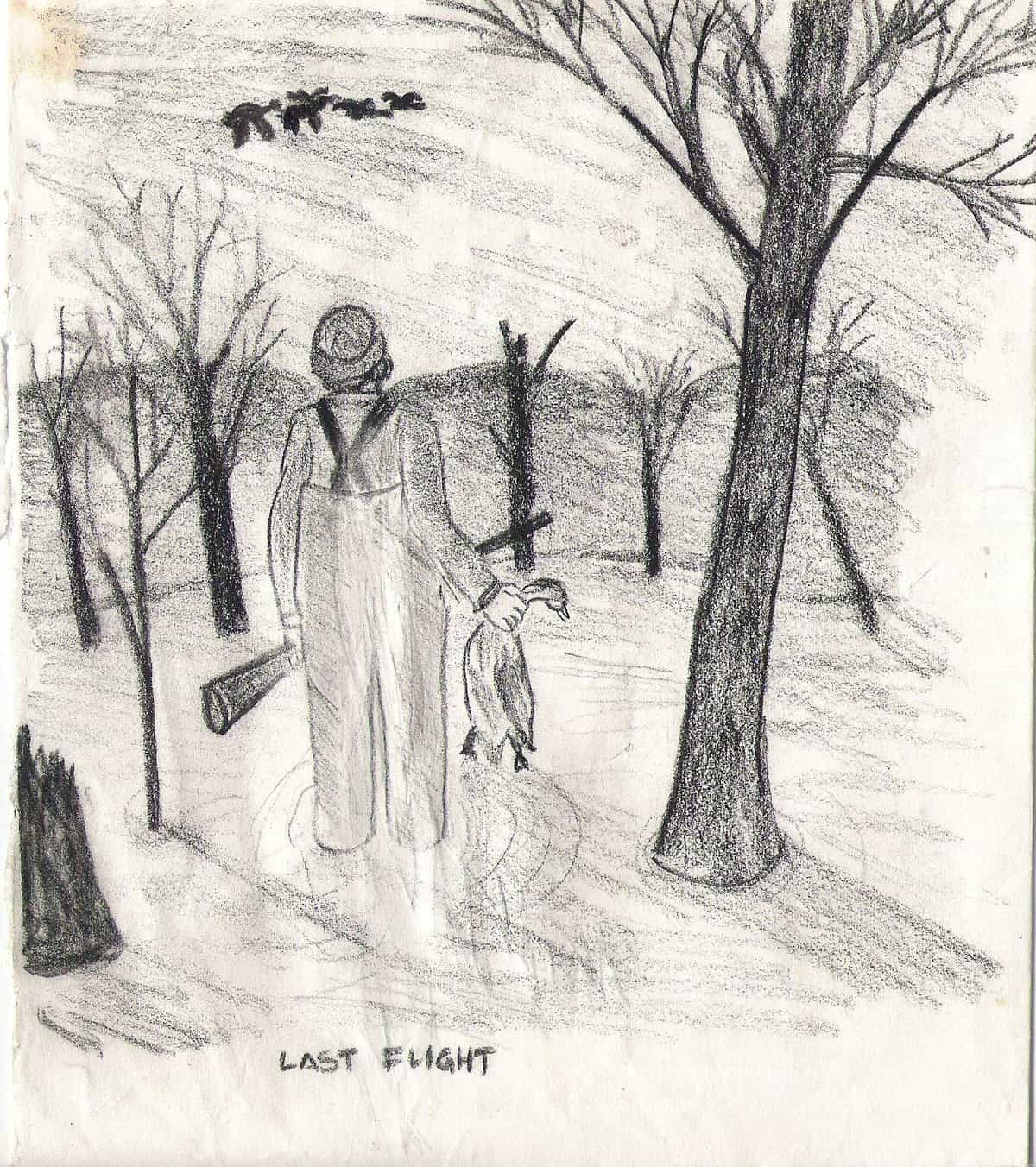
This classic story is from our third book, Wind in the Pines. Uncle Quincy’s Goose “He who guards his mouth and his tongue keeps himself from calamity.” -Proverbs 21:23 This gift of human communication is a wonderful thing. But the corresponding trouble this ability to speak gets us in is often not good. Solomon in his book of wisdom called Proverbs makes a statement: “Even a fool is thought wise if he keeps silent.” We’ve all had experiences where we learned the merits of keeping our mouths shut. It is a sad and true fact that words, once uttered, cannot be taken back. I close with what is probably my favorite story on our words and the folly they can create: My great-great uncle Quincy died before I was born. All that I knew of him came from his niece, my precious Grandma Pearl. She loved telling stories of her mother’s family and their lives in the Cajun community of Oberlin. Mama Pearl had many good stories, but the one she loved telling best was how her Uncle Quincy escaped from Angola Prison by swimming on the back of a mule across the Mississippi River. Mama’s beautiful blue eyes would sparkle as she told of his visit a few nights later to gather some items he needed. She related that was still dressed in his prison clothes after hopping a series of freight trains and car rides to get back home. As I became older, it amazed me at how the Godliest person I’ve ever known – my grandma, could be so proud of her uncle who had escaped from prison. But she loved her family and was always glad to tell the story one more time. She told this specific story about a goose hunt Uncle Quincy went on. He and two other men were hunting in the rice fields near Oberlin. They had an extremely successful hunt, shooting down many geese. Laying out their collection of dead geese they were surprised to see that one of the birds had a large metal band on its leg. Closer scrutiny revealed the band had a number and instructions on how to forward this number to the National Wildlife Service. A further count surprised them that they were one goose over the limit. A quick recount confirmed the fact they had one too many geese to be legal. They were not about to leave a goose behind, so they picked up their geese, tying their legs of the geese together and hoisted them over their shoulders. Nearing the edge of the field and their vehicle, they decided to leave behind one of the geese at the fence corner. This would mean they would be right on the limit of geese. Their plan was to come back and get the lone goose if they didn’t encounter a game warden at their vehicle. It was a good decision because a federal game warden was waiting for them in the bushes near their vehicle. Together the men laid their geese in a line for counting, placed their guns on the ground for inspection, and took their licenses out of their wallets. Federal game wardens are pretty picky and are not beholden to the local politics that state wardens must endure. It took a while for the inspections and counting to take place. There just seemed to be need for a little small talk to make the time move quicker, so Uncle Quincy decided to liven up the conversation with this innocent remark, “You know one of those geese we killed had a metal band on its leg.” The federal game warden stood up from his inspection. It was evident he was very interested in Uncle Quincy’s statement. He asked, “Really, I’d like to see it and record the number for our study.” (Reader, now I know you are probably getting ahead of me here, but I’m peddling as fast as I can!) The hunters and the game warden began to look for the goose with the metal band. After several attempts sorting through several dozen geese and finding no leg band, the warden looked up quizzically at Uncle Quincy. Now, you already know what Uncle Quincy and his hunting buddies knew: the goose with the leg band was “hiding” back in the weeds at the fence corner. Finally, after the four of them searched through the geese once more, the game warden’s stare met Uncle Quincy’s eyes. Uncle Quincy couldn’t think of but one thing to say, “Well, I guess it must have fallen off between here and the blind.” With that the game warden snorted disgustedly, abruptly stopped his inspection, and left without saying another word. After the game warden got out of earshot, Uncle Quincy made a classic statement to his hunting partners, “Well, they’ve never sent a man to the pen for keeping his mouth shut!” I often think of Uncle Quincy’s goose when I get in a bind due to excessively running my mouth. The wise writer of Proverbs said it well, “Where there is abundance of words, sin is not absent.” Even James, the brother of Jesus said it so well, “If anyone considers himself religious and yet does not keep a tight rein on his tongue, he deceives himself and his religion is worthless.” Jesus best summed it up: “But I tell you that men will have to give account on the Day of Judgment for every careless word they have
What is The Creek? This week’s LLL Letter.

Our weekly The Creek Letter isn’t meant to be one-sided. We love hearing from readers and friends! We enjoy your emails and Facebook messages. The painting below is by my Uncle, Bill Iles. It depicts Crooked Bayou, the stream flowing through our family’s homestead in Dry Creek. What is The Creek? In a word, it’s a way of life. A way of looking at life. In my long list of future books, I plan a book called The Pineywoods Manifesto. It will be written for boys like my grandsons. I want to pass on the tried and true ways that make our part of Louisiana so special. In everything I write, I wish to pass on this wisdom of the woods that I learned from my ancestors. Here a few subjects I’ll expound on in The Pineywoods Manifesto: If a job is worth doing, it’s worth doing right. You are your brother’s keeper. Don’t let anyone take a photo of you naked. (I’m serious). Carefully choose your hills to die on. Don’t forget where you came from. What subjects and bromides do you want to pass on? 1. My word for the week: Gratitude What a fine word. It’s a habit. A lifestyle. I want more of it. Thanksgiving shouldn’t be a day or even a month. It should be a daily attitude. Link to see my current 6+ Words List. 2. A Quote: Link to the Creekbank Quotes page. 3. A Scripture for the Journey Make a joyful noise to the Lord, all the earth! Serve the Lord with gladness! Come into his presence with singing! -King David in Psalm 100 4. Featured Book: Christmas Jelly It’s always a thrill to hear from readers who’ve enjoyed Christmas Jelly, our holiday book celebrating Christmas in the woods. Features additional stories for “Bah Humbug”* week. We’re selling Christmas Jelly for $10.00 plus $5.00 shipping. Learn more here. * Bah Humbug week is the infamous week after Christmas. 4. Blogs I’m following: as an LLL (Life Long Learner) I’m always searching for new ideas and personal growth. These are my current favorites: 1. Michael Hyatt: cutting edge on tech productivity. 2. Seth Godin: short, insightful blog posts. 3. Russell Moore: conservative and deep thinker on current issues. 4. Lifehacker: a little bit of everything. 5. A current favorite photo This is our longleaf pine field from my deer stand. So thankful for my deep roots in the woods. 6. Here are links to this week’s blogs at the Creekbank. A Stranger in a Strange Land The Flag: A Tale of Two Caps As the Crow Flies Sample Chapters 7. Grant Christmas Tree Farm is the best family holiday event in Louisiana. It’s operated by our friends, Gray and Mollie Anderson and their family. A day at the farm is one your family will never forget! I’ll be greeting and signing books at Grant on these dates: Friday, Nov. 25 Saturday, Nov. 26 Saturday, Dec. 3 Saturday, Dec. 10 Learn more at www.grantchristmastreefarm.com 8. Praying for DeDe and me: Thank you for praying for me during a recent bout of depression. Thanks to your prayers and my wonderful doctors, I’m doing better. I’m so grateful. Thank you for praying for our revision of As the Crow Flies. I’m making good progress towards a May 2017 release. You can help here. I’m so thankful for my wife DeDe. This weekend we celebrate our first date 40 years ago. (I still have the program from the event). Pray that I’ll grow as a husband and friend. Readers are enjoying our new book, Trampled Grass. You can easily order your copy here. We’ll send your autographed book with an invoice. View all 12 of our book covers. 10. Hotlinks Our Creekbank About Page Baptist Press on Trampled Grass Trampled Grass review/Beauregard Daily News Wayfaring Stranger: “This should be a movie.” If you’re enjoying this story letter, forward it to a friend. If you’d like to subscribe to future blogs, click here. If you have any comments, suggestions, or criticisms, email us at creekbank.stories@gmail.com
Stranger in a Strange Land
He was a Stranger in a Strange Land. How many days has it been Since I was born How many days until I die -Leon Russell Apr 02, 1942 – Nov 13, 2016 (age 74) Watch Leon perform “Stranger in a Strange Land.” If the date calculator I used is correct, Leon Russell lived 27,254. That’s a lot of days. 27, 254 days How many days since I was born? How many days until I die? I always liked the music of Leon Russell, especially after seeing him live. In about 1980, Leon, his wife Mary, and band traveled with Willie Nelson. I’ve always tried to attend a Willie Nelson concert when possible. That night we got a double shot. Leon Russell sang with a growl, beat on his keys, and his wife showed her Gospel roots. Willie, as always, put on a fine show. Then Leon joined Willie on stage and they sang and played until late in the night. They sang various styles and looked like they were having a good time. And when a musician/band looks like they’re having fun, the audience will too. It was a night to remember. All of this came back to me with Leon’s death on Sunday. I went through my Leon playlist and was reminded of why I loved his music. If you have Spotify or Pandora, take a listen. You won’t get the full effect until you listen to one of his live albums. On one live song, he promises the audience, “If you put on a show for me, I’ll put on a show for you.” Fair deal if you ask me. I always wondered about Leon’s faith. He loved singing Gospel and lots of his songs had those faith-themes that most Southern writers/songwriters have. (He was born in Oklahoma). Here’s an example: And the baby looks around him And shares his bed of hay With the burro in the palace of the king He’s a stranger in a strange land My favorite song of his was “A Stranger in a Strange Land.” I often played it during my African sojourn. The song (full lyrics are below) spoke to my heart. I truly felt like a stranger in a strange land. My current novel, As the Crow Flies, has a chapter entitled, “Stranger in a Strange Land.” You can read it here. Scroll down to chapter 4. Watch Leon perform “Stranger in a Strange Land.” Rest in peace, Leon. Complete lyrics to Stranger in a Strange Land Stranger in a Strange Land Leon Russell How many days has it been Since I was born How many days until I die Do I know any ways That I can make you laugh Or do I only know how to make you cry When the baby looks around him It’s such a sight to see He shares a simple secret With the wise man He’s a stranger in a strange land Just a stranger in a strange land Tell me why He’s a stranger in a strange land Just a stranger in a strange land How many miles will it take To see the sun And how many years until it’s done Kiss my confusion away in the night Lay by side when the morning comes And the baby looks around him And shares his bed of hay With the burro in the palace of the king He’s a stranger in a strange land Tell me why He’s a stranger in a strange land Just a stranger in a strange land Well, I don’t exactly know What’s going on in the world today Don’t know what there is to say About the way the people are treating Each other, not like brothers Leaders take us far away from ecology With mythology and astrology Has got some words to say About the way we live today Why can’t we learn to love each other It’s time to turn a new face To the whole world wide human race Stop the money chase Lay back, relax Get back on the human track Stop racing toward oblivion Oh, such a sad, sad state we’re in And that’s a thing Do you recognize the bells of truth When you hear them ring Won’t you stop and listen To the children sing Won’t you come on and sing it children He’s a stranger in a strange land Just a stranger in a strange land Songwriters: DON J. PRESTON, LEON RUSSELL © Universal Music Publishing Group For non-commercial use only. Data from: LyricFind Of Thee I Sing Hung up in a Pennsylvania mining town Got down to Boston in time for tea Don’t know exactly just what’s going down Better hang around until I see. She uses beauty like a knife She cuts me even more, she changes Right before my eyes into something ugly and sore. Beauty like a knife She cuts me even more, she changes Right before my eyes into something strange and more. Don’t bomb the inn, I’m on a holiday But Oklahoma’s just a jet away And the blood is on the books in Ohio So badly stained, what can I say?
A Story for the Flag: “The Tale of Two Caps”

“A Tale of Two Caps” is from our third short story collection, Wind in the Pines. With our current American conversation over a divided nation, I was reminded of this story. It’s a timely reminder about the strengths of our country and the challenges we have. I grew up in a home where my parents never judged people by the color of their skin or the money in their bank account. My dad and mom taught us, by word and example, to deal with all people with respect. Even though I grew up in an all-white community, my parents taught us how to respect others. I never heard my parents use any racial slur. When the first black family came to our school, I sat by one of them, Wilford Goodley, at lunch and received taunts from prejudiced classmates. It only made me more determined. The story below, A Tale of Two Caps, shares about a racially divisive issue we dealt with at Dry Creek Camp. It’s a good time to pull out this story about dealing with an old problem. It’s a story about understanding and flexibility. It’s about putting yourself in another man’s shoes, or in the case of this story, another man’s cap. View a stirring short message about the Confederate flag by Dr. James Merritt of Atlanta, Georgia. A Tale of Two Caps Dry Creek Baptist Camp Circa 2000 Years as a high school administrator taught me to “smell trouble.” That was the case on a night of summer youth camp. The evening service had just ended and campers roamed the area around the snack shack and main road. There was a large group of about twenty-five campers near the road. I could tell something was up. Tension could be felt just walking past this group. I walked over, “Hey guys, what’s going?” The crowd parted slightly but no one was willing to tell me anything. Then I saw “Randall” and figured he was the person everyone was gathered around. I’ve always liked Randall. I had gotten to know him better the previous summer when we made a late night emergency room visit together. Randall is what I call a “man-child.” Although only fourteen at the time, he was a big boy– about six-foot-two and a good 250 pounds. He had the look and size of a high school football lineman. I pulled him to the side and said, “Now Randall, I know something is going on. Tell me what the trouble is.” He hesitated. “Brother Curt, I’ve had trouble with some of those boys in cabin 7 and they won’t leave me alone.” Looking at Randall and then thinking of what groups were in cabin 7, I knew what the trouble was probably about. Randall was wearing a cap with a Confederate flag on it. One of our groups in cabin 7 was an inner city youth group from the Alexandria area. This group, which had had a great time this week, was composed entirely of black teens. I turned to Randall, “Hey, let’s go over here where we can talk.” I asked him to take off his cap and put it in his pocket. “Randall, does this trouble have anything to do with your cap?” He mumbled a unconvincing denial. I sat him in one of our outdoor pavilions. “You wait here.” I walked to Cabin 7. The campers were milling around on the porch. I tried to think of how to defuse this situation. That was the exact moment when I spotted the solution to this problem: his name was Ty. He was the oldest and tallest camper from this inner city group. I’d spoken to him several times this week and liked his quiet nature and shy smile. I’d watched him on the basketball court and the old coach in me recognized skill and grace. I called Ty over. “Could you help me out?” Ty looked at me suspiciously as we walked away. “There’s a problem I could us your help on.” He cautiously said that he would try, but still seemed non-committal about getting involved. Ty was also wearing a cap, but it sure wasn’t a rebel cap. It was a thin black nylon stocking cap popular among many black teens. We walked over to Randall under the pavilion, I looked at both boys and their caps – Ty’s black cap on his head and Randall’s confederate cap sticking out of his back pocket. There was a wide chasm that these two caps represented and I knew my work was cut out for me. We sat down and I introduced the boys to each other by name. They’d spent most of this day glaring at each other. Now they were no longer nameless but instead were sitting by each other in the darkness on an old church pew. I turned to Ty, “Does Randall’s hat bother you?” He stared off into the darkness. “Well it doesn’t bother me too much, but there are some of the guys in our group are upset by him wearing it.” I asked Randall if he knew why this rebel flag cap bothered these guys from Alexandria. He kind of hemmed and hawed before shrugging, “Well, I just don’t think it ought to bother those guys.” I shared with him how the same flag that meant freedom and Southern pride to him meant something completely different to a black man. To them it was a symbol of slavery, oppression, and prejudice. With that I switched on my flashlight and turned to I Corinthians 8 in my pocket Bible. In this famous passage the Apostle Paul addresses the problem in Corinth of eating meat that had been sacrificed to idols. Paul clearly stated that the actual eating of the meat was in no ways a sin, but he added a passage of wisdom that is still