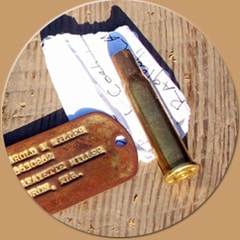
A Memorial Day Story Worth Telling: A Soldier’s Story
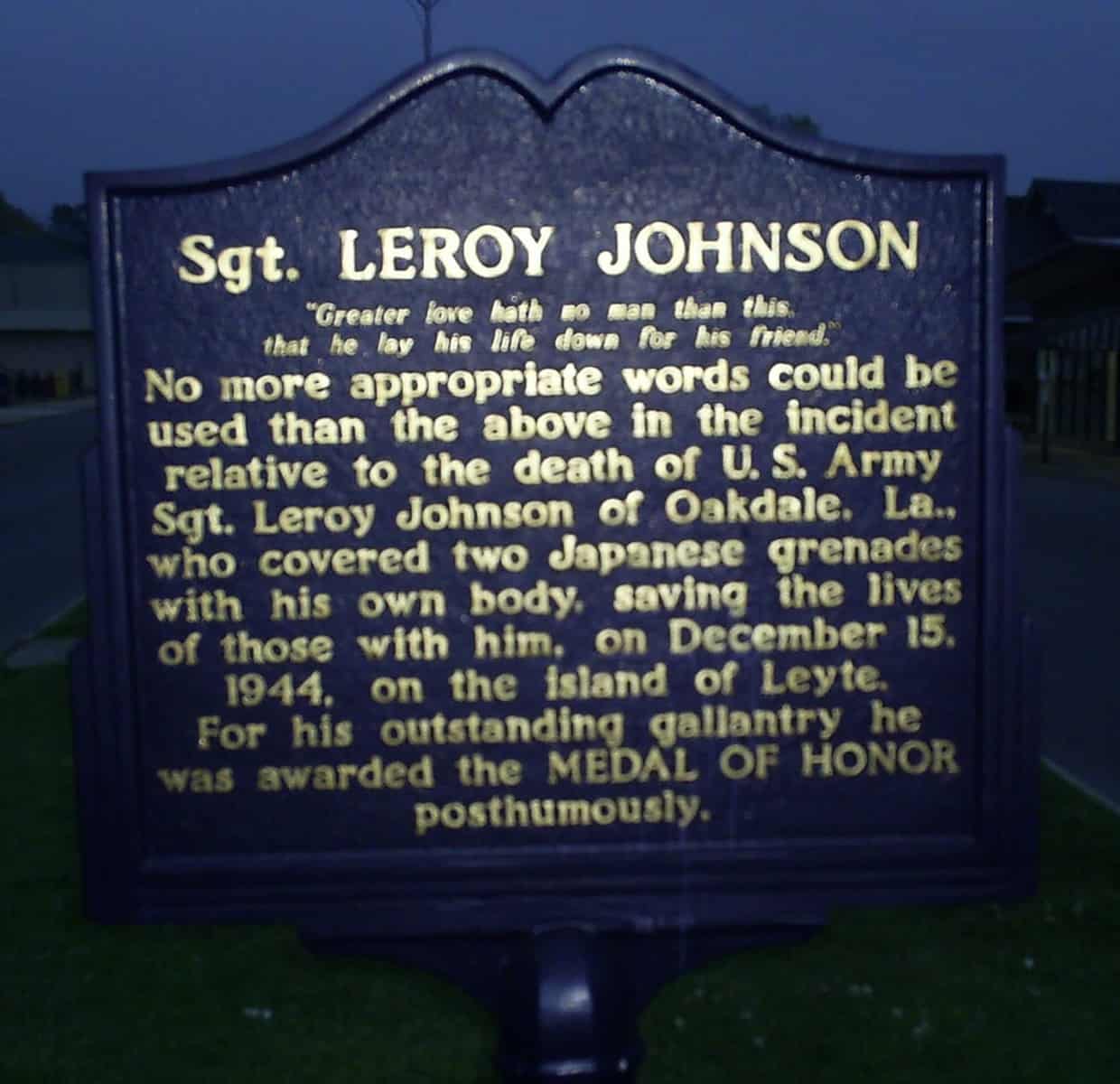
A Note from Curt: As long as I’m alive, I will tell the story of Sgt. Leroy Johnson. It’s a story worth telling, worth passing on. We need to be reminded that freedom is never free. It’s important to remember stories of heroes who paid with their lives for our American freedom. There is no better example of this than Sgt. Leroy Johnson of Oakdale, Louisiana. Sergeant Leroy Johnson U.S. Army 1941-1944 A Soldier’s Story Since 1965, a bronze plaque has stood on the median of Louisiana Highway 10 in the town of Oakdale. This plaque summarizes the story of Sergeant Leroy Johnson. The inscription on the plaque ends with the wonderful words of Jesus from John 15:13, Greater love has no one than this, that he lay down his life for his friends. Leroy Johnson was born on December 6, 1920, near Caney Creek, Louisiana. His father was a carpenter, and his mother was busy rearing a large family. Growing up, Johnson knew what it was like to work hard and do the best he could with what he had. Men like Leroy Johnson, who later fought in our greatest war, grew up during our nation’s hardest time—the Great Depression. I believe these hard years helped train the soldiers who later won in Europe and the Pacific. Many young men of this generation found work with the Civilian Conservation Corps. The “C.C.C. Camps,” as they were called, gave these men jobs and some income (most of which was sent home to their families). Most importantly, the C.C.C. gave young men a sense of self-respect and work skills. Additionally, they learned to live and work together, a trait that came in handy during the war years of the next decade. Leroy Johnson worked in one of the many camps in the Kisatchie Forest of central Louisiana. In 1941, prior to Pearl Harbor and the outbreak of war, Leroy Johnson joined the Army. His departure for boot camp marked the last time he would see his family and be home in Allen Parish. Evidently, the Army agreed with him. From his letters home and comments from the men he served with, he was born to be a soldier. They placed him in the 32nd Infantry Division. Most of the men in this Division were from the northern states of Wisconsin and Michigan. This division was involved in the large-scale 1941 maneuvers then being held in the forests of Louisiana. They plugged new Southern enlistees like Johnson into these units. From reading his service letters and the history of this division, we can track his travels over the next few years of the war. He was part of the campaign to take the eastern portion of New Guinea from the Japanese. This invasion was to stop the Japanese advance toward Australia. General MacArthur stated his strategy when he said, “We will protect Australia from New Guinea.” Reading the official division history, the jungle fighting on this large island was difficult, slow, and deadly. The Japanese troops were experienced jungle fighters. The 32nd Division, which would later spend more days in actual combat than any other division in the war, was green and untried. He was awarded the Purple Heart as well as two Silver Stars for gallantry. Sgt. Johnson spent part of the next year recuperating in Australia from his wounds in New Guinea. The 32nd Division, or Red Arrow Brigade as its men called it, was part of the 1944 invasion of the Philippines. The fighting with the Japanese on the many islands of this country was tough and deadly. Company K, in which Sergeant Leroy Johnson served, landed on the eastern Philippine island of Leyte. As they fought their way inland, they reached an area near the Filipino city of Limon. Company K’s commanding officer was Johney B. Wax. Captain Wax, also a Louisianan, had been Johnson’s commanding officer for several months. The brave act for which Leroy Johnson won the Congressional Medal of Honor is best described in the following documents. The first is the official Army citation of his heroism on December 15, 1944. Official Citation: Congressional Medal of Honor On 12/15, 1944, Sgt. Johnson was the squad leader of a nine-man patrol sent to scout a ridge held by a well-entrenched enemy force. Seeing an enemy machine gun position, he ordered his men to remain behind while he crawled within six yards of the gun. One of the enemy crew jumped up and prepared to man the weapon. Quickly withdrawing, Sgt. Johnson rejoined his patrol and reported the situation to his commanding officer. Ordered to destroy the gun, which covered the approaches to several other enemy positions, he chose three men, armed them with hand grenades, and led them to a point near the objective. After taking partial cover behind a log, the men had knocked out the gun and began an assault when hostile troops on the flank hurled several grenades. As he started for cover, Sgt. Johnson saw 2 unexploded grenades that had fallen near his men. Knowing that his comrades would be wounded or killed by the explosion, he deliberately threw himself on the grenades and received the full charge in his body. Fatally wounded by the blast, he died soon afterward. Through his outstanding gallantry in sacrificing his life for his comrades, Sgt. Johnson provided a shining example of the highest traditions of the U.S. Army. His commanding officer, Captain Johney Wax, sent the following letter to Johnson’s family. October 16, 1945 Dear Mr. and Mrs. Johnson, Several times during the last few months I have received good news, but none made me any happier than when I picked up last Monday’s Times-Picayune and learned that your son had been awarded the Congressional Medal of Honor. He