Creekbank Stories

A Memorial Day Story Worth Telling: A Soldier’s Story
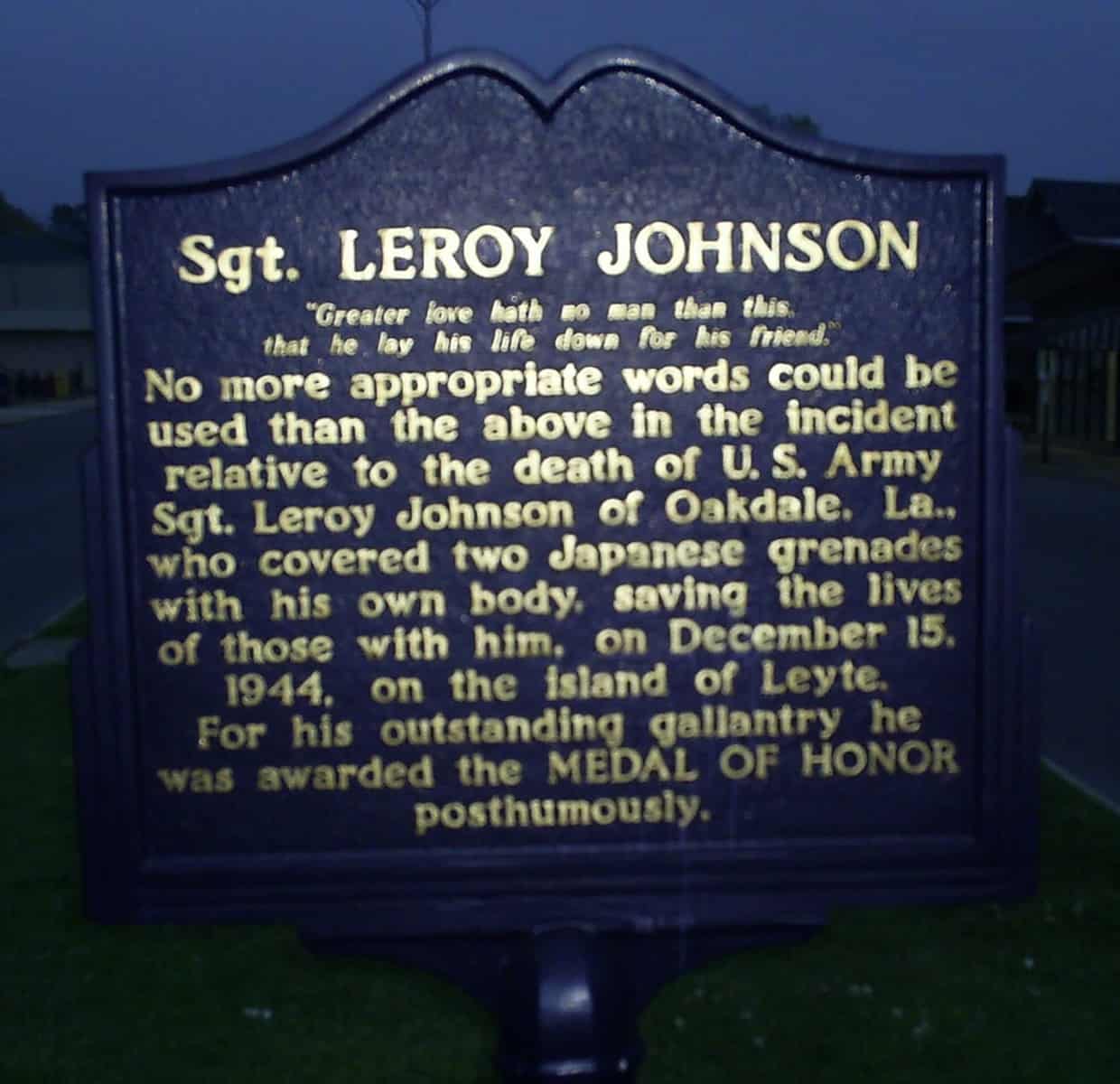
A Note from Curt: As long as I’m alive, I will tell the story of Sgt. Leroy Johnson.     It’s a story worth telling, worth passing on.  We need to be reminded that freedom is never free. It’s important to remember stories of heroes who paid with their lives for our American freedom. There is no better example of this than Sgt. Leroy Johnson of Oakdale, Louisiana. Sergeant Leroy Johnson                                                   U.S. Army 1941-1944 A Soldier’s Story Since 1965, a bronze plaque has stood on the median of Louisiana Highway 10 in the town of Oakdale. This plaque summarizes the story of Sergeant Leroy Johnson. The inscription on the plaque ends with the wonderful words of Jesus from John 15:13, Greater love has no one than this, that he lay down his life for his friends. Leroy Johnson was born on December 6, 1920, near Caney Creek, Louisiana. His father was a carpenter, and his mother was busy rearing a large family. Growing up, Johnson knew what it was like to work hard and do the best he could with what he had. Men like Leroy Johnson, who later fought in our greatest war, grew up during our nation’s hardest time—the Great Depression. I believe these hard years helped train the soldiers who later won in Europe and the Pacific. Many young men of this generation found work with the Civilian Conservation Corps. The “C.C.C. Camps,” as they were called, gave these men jobs and some income (most of which was sent home to their families). Most importantly, the C.C.C. gave young men a sense of self-respect and work skills. Additionally, they learned to live and work together, a trait that came in handy during the war years of the next decade. Leroy Johnson worked in one of the many camps in the Kisatchie Forest of central Louisiana. In 1941, prior to Pearl Harbor and the outbreak of war, Leroy Johnson joined the Army. His departure for boot camp marked the last time he would see his family and be home in Allen Parish. Evidently, the Army agreed with him. From his letters home and comments from the men he served with, he was born to be a soldier. They placed him in the 32nd Infantry Division. Most of the men in this Division were from the northern states of Wisconsin and Michigan. This division was involved in the large-scale 1941 maneuvers then being held in the forests of Louisiana. They plugged new Southern enlistees like Johnson into these units. From reading his service letters and the history of this division, we can track his travels over the next few years of the war. He was part of the campaign to take the eastern portion of New Guinea from the Japanese. This invasion was to stop the Japanese advance toward Australia. General MacArthur stated his strategy when he said, “We will protect Australia from New Guinea.” Reading the official division history, the jungle fighting on this large island was difficult, slow, and deadly. The Japanese troops were experienced jungle fighters. The 32nd Division, which would later spend more days in actual combat than any other division in the war, was green and untried. He was awarded the Purple Heart as well as two Silver Stars for gallantry.   Sgt. Johnson spent part of the next year recuperating in Australia from his wounds in New Guinea. The 32nd Division, or Red Arrow Brigade as its men called it, was part of the 1944 invasion of the Philippines. The fighting with the Japanese on the many islands of this country was tough and deadly.  Company K, in which Sergeant Leroy Johnson served, landed on the eastern Philippine island of Leyte. As they fought their way inland, they reached an area near the Filipino city of Limon. Company K’s commanding officer was Johney B. Wax. Captain Wax, also a Louisianan, had been Johnson’s commanding officer for several months.  The brave act for which Leroy Johnson won the Congressional Medal of Honor is best described in the following documents. The first is the official Army citation of his heroism on December 15, 1944.     Official Citation: Congressional Medal of Honor On 12/15, 1944, Sgt. Johnson was the squad leader of a nine-man patrol sent to scout a ridge held by a well-entrenched enemy force. Seeing an enemy machine gun position, he ordered his men to remain behind while he crawled within six yards of the gun. One of the enemy crew jumped up and prepared to man the weapon. Quickly withdrawing, Sgt. Johnson rejoined his patrol and reported the situation to his commanding officer. Ordered to destroy the gun, which covered the approaches to several other enemy positions, he chose three men, armed them with hand grenades, and led them to a point near the objective. After taking partial cover behind a log, the men had knocked out the gun and began an assault when hostile troops on the flank hurled several grenades. As he started for cover, Sgt. Johnson saw 2 unexploded grenades that had fallen near his men. Knowing that his comrades would be wounded or killed by the explosion, he deliberately threw himself on the grenades and received the full charge in his body. Fatally wounded by the blast, he died soon afterward. Through his outstanding gallantry in sacrificing his life for his comrades, Sgt. Johnson provided a shining example of the highest traditions of the U.S. Army.       His commanding officer, Captain Johney Wax, sent the following letter to Johnson’s family.   October 16, 1945 Dear Mr. and Mrs. Johnson,   Several times during the last few months I have received good news, but none made me any happier than when I picked up last Monday’s Times-Picayune and learned that your son had been awarded the Congressional Medal of Honor.   He

Amazing: A WWII story you’ll have to share

A word from Curt: Amazing!  What a good word. During this current season of my life, my writing (and life) is focused on three things: Staying Curious. Being Amazed. Telling Stories that Resonate. This story, told by my friend and mentor, Ron Perry, is my favorite story of 2016. Read. Be amazed. Share it. SOMEONE IS PRAYING FOR YOU It was WWII and a convoy had reached the edge of a jungle in the China-Burma-India Theater. There they stopped and set up camp for the night. Gene, a tall lanky soldier from Missouri, had stretched his hammock between two trees and like the rest of his company had settled in for a night of rest. Some time in the night he was awakened and turned around in his hammock, then went back to sleep. Later he was awakened with excruciating pains in his legs only to find himself being dragged from his hammock by a Bengal tiger. His comrades were awakened and they were able to scare the tiger and it released its jaws and dropped Gene to the ground, saving his life. When daylight came they found tiger paw prints around each hammock, yet it chose Gene as its victim. He spent many months in hospitals and rehab facilities. Back home was a Godly mother who knew how to pray and had spent hours interceding for her family and especially for her son in the jungles of Burma. After returning home and sharing his story with family he would realize the effectual praying of his mother in the night of his greatest danger. God had awakened Gene to turn around in his hammock. If he had not turned around more than likely the tiger would have attacked his head or throat and possibly killed him. If that would have happened I would not have met his lovely and talented daughter, Debbie, and Roy O Martin Companies would not have had the opportunity to know her as a compassionate and caring chaplain. Go with me to John 17 and visualize our Lord going into his dark night alone to pray. There is recorded the intercessory prayer of Jesus to his Heavenly Father, first for himself, then his disciples, and then for you and I. Jesus prays for our safety – verse 11 and 15, for our satisfaction in daily living –verse 13, for our separation from the world – verses 14-16, and for our sanctification and service – verses 17-19. Jesus is calling all of us to join his team of faithful intercessors to pray for carefree sons and daughters, grandsons and granddaughters, family, friends, and coworkers who face the enemy of their souls, “who prowls around as a roaring lion looking for some one to devour.” 1 Peter 5:8 By the way, Gene will be 90 on September 11, 2014. In May I had an opportunity to visit with him at his country home in Hazel, Kentucky and hear in greater detail the story of his deliverance on that dark night. Across the years my family and I have been the benefactors of his prayers of intercession. I am eternally grateful to God for delivering him from the jaws of that Bengal tiger in the jungles of Burma. In your dark night, remember, someone is praying for your deliverance! Prayerfully, Chaplain Ron Note: Debbie Perry’s father, Gene, died last year after living seventy plus years after his fateful tiger attack.  

It’s Corporal Vidrine’s Birthday

Corporal Howard Vidrine When I came to work at Dry Creek as a thirteen-year-old, one of the first people I met was Howard Vidrine. He served as the camp night watchman during my early years at camp. “Bro. Vidrine,” as we called him, lived in the Evangeline Parish town of Reddell, which is next door to the unique village of Mamou, located in the deepest heart of Louisiana’s Cajun country. Forty years after I first met him at camp, Howard Vidrine is still a part of our camp family. In fact at the time of this writing, he is staying with us in his own personal cabin at camp. The first thing I noticed about Howard Vidrine was his rich Cajun brogue. I love all Acadian accents, but there is something so different about the unique accent of Evangeline Parish residents. It has a character all of its own. I’ve always said if I was walking down the street in New York City and heard someone from Ville Platte or Mamou speaking, I’d recognize where they were from. Bro. Vidrine is a bachelor, at least as I write this. Being eighty-one years old (Don’t dare ask him his age!) and pretty set in his ways, I doubt he’ll find a wife at this point, but you never know. Throughout the years he has been a fixture at Dry Creek. A few years ago he moved into one of our small cabins as a special guest. We never know when he is coming or going. He just shows up and that is always fine with us. He serves a very important role at Dry Creek Camp. He is the surrogate grandpa for several generations of campers and staffers. I guess that would be the best way I could describe the role he has played in my life. Bro. Vidrine is an ordained Baptist minister. Several times he preached for us at our local church. I’ll never forget the last time when he preached as to why he wore a big bow tie. I’ve found that anywhere I traveled in this part of Louisiana, he is well known. Once several of us went to check on him at his Evangeline Parish home, but failing to find him there we found him at the local corner grocery. He told us this is where he came everyday to eat. It was neat how the young waitresses hovered over him as if they were serving royalty. As I write this, I’m sitting by his hospital bed in DeRidder. He has had kidney-stone surgery and is recuperating for a couple of days. During the last few weeks, our camp staff has taken care of him. Frank and Janet Bogard and the rest of our staff have always been so good to him and treated him as a grandpa to our staff.   During these last few weeks, I’ve had Bro. Howard tell me again about his wartime experiences during World War II. The men, who fought to keep our freedom during this most challenging war of all, are slowly but surely passing from the scene. It is important to tell their story for posterity. Here is his story: Howard Vidrine volunteered for the Army in October 1942. He went to boot camp at Fort Benning, Georgia. He then took part in the Louisiana maneuvers held in Central Louisiana which were led by Generals Eisenhower and Patton. Then he boarded a transport ship for the fourteen-day trip to Europe, his first trip very far from Evangeline Parish. They landed first in England where his division drilled for three months. Bro. Howard said, “It rained every day we were in England.” Next, his unit went to North Africa to join the war in January 1943. His battalion, the 894th Tank Destroyers, joined the battle at Kasserine Pass. Corporal Howard Vidrine was in a reconnaissance platoon. Their job was to scout out and locate Rommel’s tanks. Crawling along there in the Saharan desert sand, he saw his first German tank. It was the first of many he’d see in the coming months. This famous fight was a tank and plane battle between the Allied and Axis forces. It was during this time that the Mamou kid first worked alongside British soldiers. His main recollection was how they had their teatime daily at ten o’clock regardless of the conditions. He told me, “They really talked funny.” I couldn’t help but chuckle at him commenting on how they sounded. His division pulled back after this battle. Bro. Howard told me a disturbing story of an incident that occurred during a later skirmish. The North African campaign was winding down as the Germans retreated through Italy. Howard was driving a jeep when he picked up an Italian civilian who was visiting his family in Africa. The Italian was so excited that his home country was being liberated. They continued toward town where they stopped and picked up an American correspondent. Upon nearing town, they encountered German artillery fire and turned back. At this point, the correspondent pulled his pistol and shot the Italian dead. Bro. Howard grimaced as he shared this story. He asked the American why he shot this man. The reply was, “Well, he’s the enemy, and he might have shot us.” Over fifty years later, the pain of this episode could still be heard in his voice.   Next they boarded transports for the trip across the Mediterranean Sea to Italy. Landing at Naples they began their march northward. Upon reaching Anzio, Italy, they found no enemy. However, within a few weeks, German troops began showing up with troops, planes, and artillery and the big battle began. Bro. Howard said he spent most of the battle in foxholes, at outposts, or on patrol. He related another story that occurred during this battle: Bro. Howard and a lieutenant were on patrol. They went into a two-story house to check for Germans. They found no one in the house. The

What a Journey: From Harrisonburg to Rome

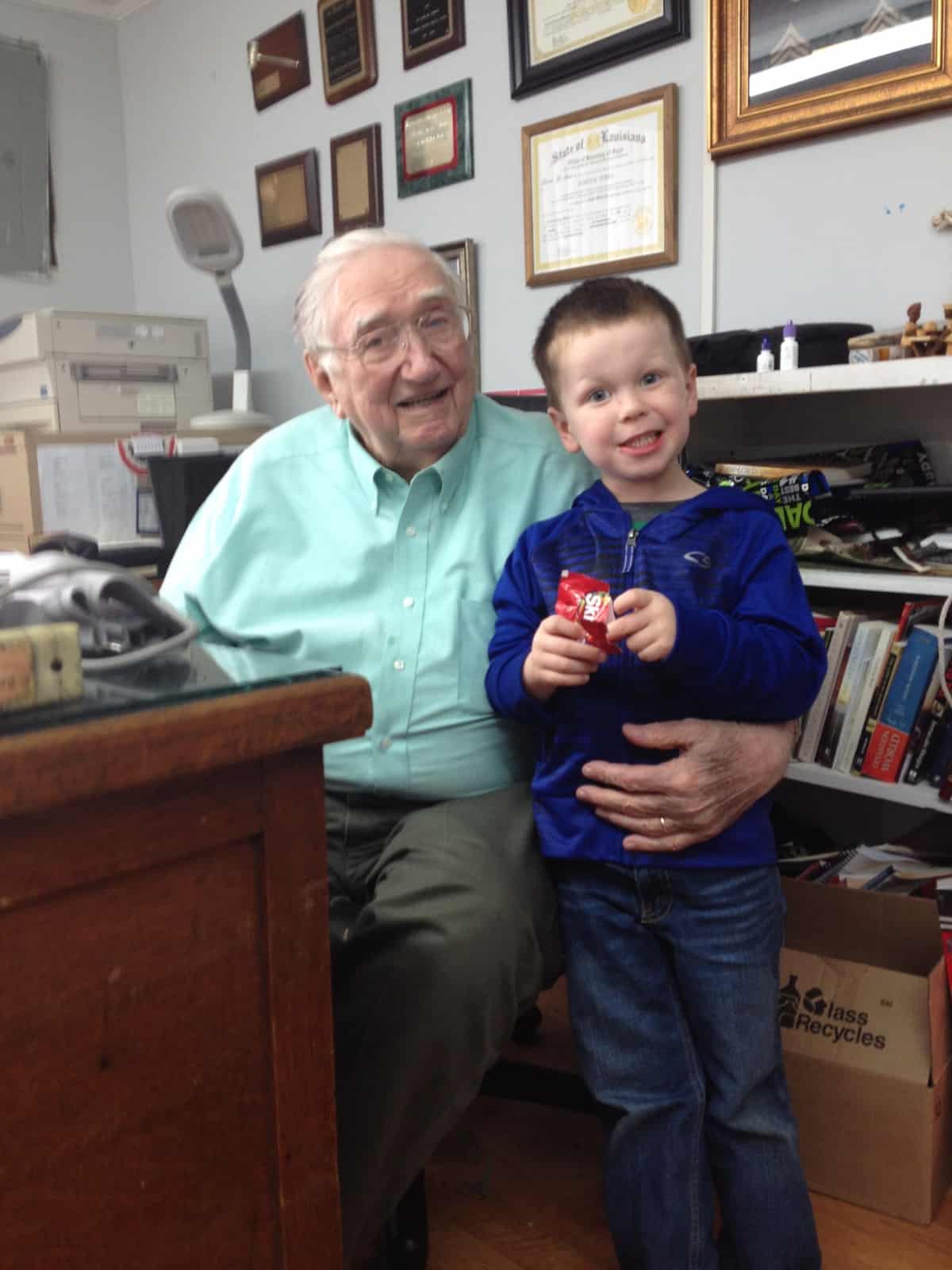
A Word from Curt: We’re on Day 11 of our Nairobi hospital stay. Today’s word is Gratitude. I’ve been without diarrhea for over 24 hours. This is the longest dry spell (literally and figuratively) since early May. Still have a long ways to go but we’re moving ahead. DeDe and I cherish your prayers.   To my early readers:   I depend (and welcome) on you to quickly notify me of any errors, glitches, or confusion in my blogs. Simply send me a snippet and we’ll correct is ASAP.  You can do this through a social media button at top of post, the comment section, or via website contact us button. Thanks in advance!   We’re in the third day of a homestand on Men and Women worth praising. If you missed the previous two posts on Sgt. Leroy Johnson and his brave sacrifice in giving his life to protect three fellow soldiers, you’ll be touched by this memorable story. The following day’s post tells of the life of Herman Clemenson, one of the soldiers saved on that fateful December 1944 day in the Philippines. Today is much more of a personal story on a veteran I loved and admired.       Staff Sergeant Terry Reports for Duty. As a boy, I watched the last veterans of The Great War—War World I—step off the stage one by one: Manuel “Curt” Green. Howard Spurlock. Dan Iles.  The long line of the Doughboys marched by. Now, I’m observing the same thing with the men and women who served our country in the Second World War. The youngest are now in their early nineties. Fewer obituaries read, “He served his country proudly in Europe” or “He was a Navy pilot in the Pacific War.” I wish to remember these folks who are deservedly called the “Greatest Generation.” That’s why I want to talk about Staff Sergeant J.H. Terry. I love reading history and biography. Recently I finished Rick Atkinson’s history of the US Army in North Africa, An Army of Dawn. It’s a tome of the first battles of our then green army. The second book in Atkinson’s trilogy, Day of Battle, details the invasion of Sicily and Italy. That’s where Sergeant Terry entered the war. Mr. Herbert, as I called the Sergeant, was a medic with the 10th Mountain Division, which joined the Fifth Army in their northward march into Europe. Only the Army would they place a Louisiana soldier in a ski mountain division. Go figure.   Herbert Terry as a young man during the time the Great Depression lessened and as the United States entered World War II. Sgt. Terry was also my father-in-law. The loving father of my wife DeDe.   In my nearly forty years with the family, I crossed the Atlantic and walked up the Italian peninsula many times with Mr. Herbert. I ate C-rations on the ship with him and leaned seasick over the railing. He shared of watching Lucille Ball in “Best Foot Forward”  eleven times on the voyage to Europe.   Sgt. Terry waded ashore in Naples and joined the huge American Army snaking up the western coat of Italy’s boot. He later saw the Pope waving from the Vatican balcony. Walked up to the Leaning Tower of Pisa. Was in Austria as the European war ended. Author’s Note: Terry Family (and others):  I’m looking for photos of Mr. Herbert in uniform as well as wedding picture of the Terry’s  Thanks! Waited for the other shoe to drop with his unit’s transfer to the Pacific and the upcoming Invasion of Japan. Was on a troop transport near Gilbratar when the atomic bombs ended the Pacific War. His ship turned around when the Japanese surrendered. Mr. Herbert loved Harry Truman and felt he owed his life to the President’s decision to drop the bombs. Regardless of how you feel about the President and the bombs at Hiroshima and Nagasaki, Mr. Herbert had a direct perspective. He strongly believed this saved the lives of thousands of American soldiers, including his own. I repeatedly heard all of the stories above. And I loved hearing them from him. I learned so much about his life and the wisdom and experience he carried with him. He and his wife, Mrs. Juanita, were survivors of two events that shaped their generation. The Great Depression. And the Great War known as World War II.   After the war, Mr. Herbert met and married Juanita Joyce, a home demonstration agent new to Catahoula Parish. With her help the the GI Bill, he returned to college at LSU and returned to Harrisonburg as an Ag Teacher. The Terry’s started a hardware store that they operated for decades with the help of their family.     Christmas was always a special time for this large family of five sons and growing generations of grandchildren and greats.     This past Christmas,  2014,  we celebrated a bittersweet holiday. We’d suddenly lost Mr. Herbert’s oldest son, Malcolm in September. Malcolm and his wife Kay lived in the Terry home, taking great care of my ninety-one year old father-in-law. DeDe and I returned from Africa to spend a month with family. We knew this visit at the end of 2014 might be the last time we were with her father. Even though we would return from Africa later in October, we sensed this was our final goodbye on earth. Unsurprisingly, it was. He died less than two months after we returned to Africa. I’ve been reviewing our final month with him.   Up until the final month of his life, he worked daily in the various businesses he owned and operated. I smile as I think about taking our grandson Luke (above) on a day trip to Harrisonburg. Mr. Terry was at work in his office, keeping Harrisonburg and the larger world safe. He looked at four year old Luke and said, “How’d you get to come by yourself?” Luke, who closely resembles the Terry clan, smiled and shrugged.   The